← Cappella Palatina Ticketsホームに戻る
パラッツォ・デイ・ノルマンニ内部の黄金のビザンティン壁画モザイクとハニカム天井 優先入場可

パラッツォ・デイ・ノルマンニ:パレルモの王宮

ヨーロッパ最古の王宮。フェニキアの石からノルマン様式の黄金へと幾層にも重なる歴史を湛え、その中心にカッペラ・パラティーナを抱く宮殿です。

2026年8月 更新 · Cappella Palatina Tickets コンシェルジュチーム

パラッツォ・デイ・ノルマンニはヨーロッパ最古の王宮であり、その上階でカッペラ・パラティーナが黄金に輝いています。宮殿全体の構造と、それを中心にした訪問計画の立て方をご紹介します。

ヨーロッパ最古の王宮

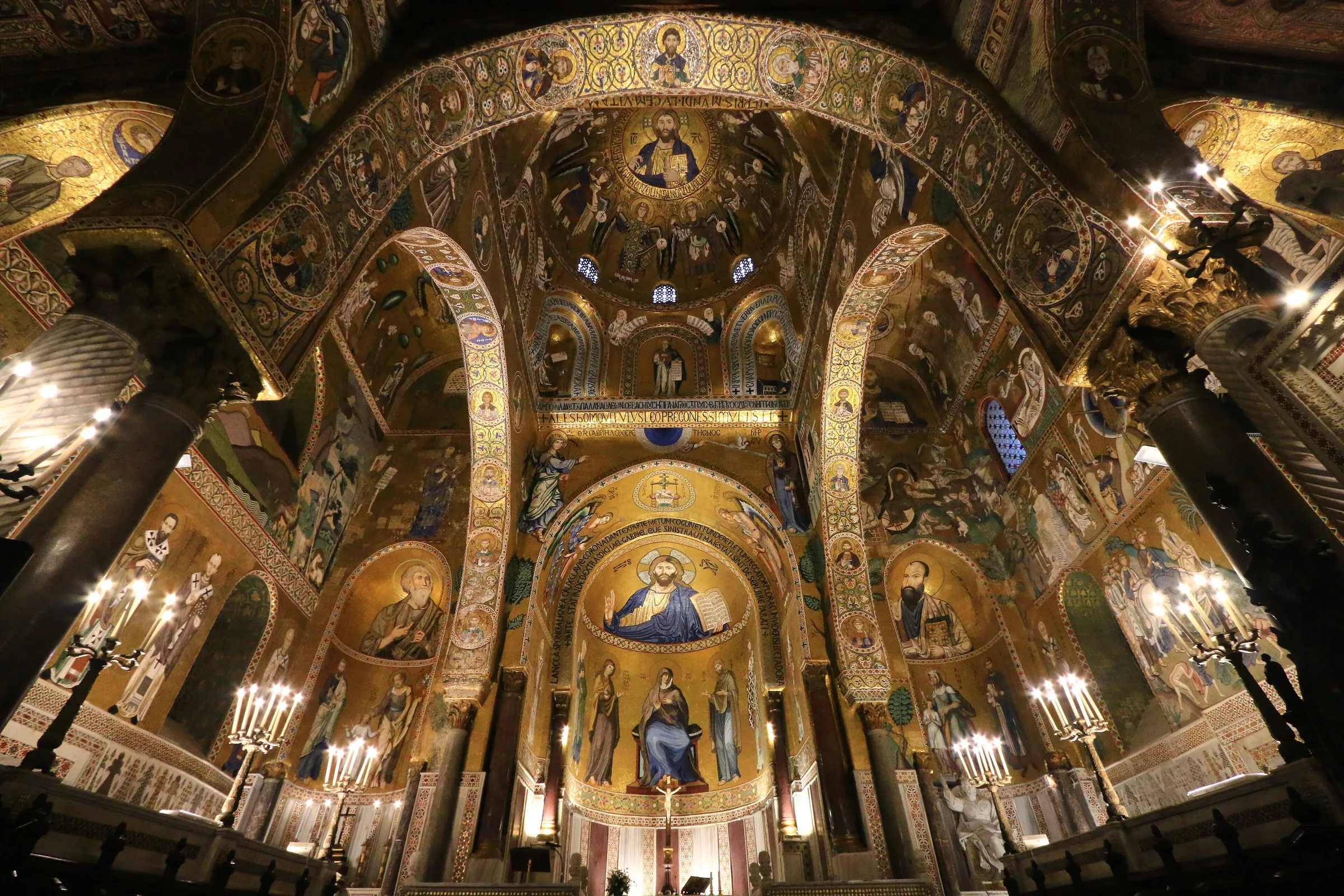
Set on the highest ground of old Palermo, near the Porta Nuova and the Piazza del Parlamento, the Palazzo dei Normanni is the oldest royal residence in Europe. That is not a marketing flourish but a plain fact of continuity: kings, viceroys and now parliamentarians have governed Sicily from this exact hill for the better part of a thousand years, and the building has never fully stopped being a seat of power. Most visitors arrive knowing it as the home of the Cappella Palatina, the dazzling royal chapel commissioned by King Roger II, whose construction began in 1132 and which was consecrated in 1140. The chapel sits on the piano nobile, the noble upper floor, and it remains the reason most people climb the hill. Yet the chapel is one jewel in a much larger setting. The palace is a working building today: it houses the Sicilian Regional Assembly, and the chamber where the island's laws are debated occupies rooms only a corridor or two from the Byzantine mosaics. That living function shapes what you can see and when, because the parts of the palace given over to government are not always open to the public. Approaching it, you feel the layers before you read a single label. The lower walls are heavy and defensive, the product of an age when this was a stronghold; the upper floors are lighter, more courtly, the work of centuries of ceremonial life. Understanding the Palazzo dei Normanni as a whole, rather than as a single famous chapel, is the key to a satisfying visit, and it explains why the ticket, the opening days and the route through the rooms all reward a little planning before you arrive.

幾層にも重なる歴史を持つ宮殿:フェニキア、ローマ、アラブ、ノルマン、スペイン

Few buildings in Europe hold their history as visibly as this one. Dig beneath the courtyards and you reach Punic and Roman foundations, the earliest stone laid when the hill first became a fortified site above the harbour. On those foundations, rulers of Arab Palermo raised a fortress, using the elevated ground to command the city and the plain beyond. When the Normans took the island in the eleventh century, they did not tear the stronghold down; they adopted it, enlarged it and turned a military citadel into a royal palace, adding the grand halls, the chapel and the towers that gave the complex its courtly character. This is why the Palazzo dei Normanni feels simultaneously like a castle and a court. Later still, under Spanish viceregal rule, the palace was remodelled again for a new kind of ceremony. Grand staircases, a monumental courtyard with tiered loggias, and reworked state rooms gave the building the more formal, Renaissance-and-Baroque face that greets you from the main square today. Each era left its grammar in the fabric: thick defensive masonry from the Arab and early Norman phases, golden mosaic and honeycombed ceilings from the Norman court at its height, and the ordered arcades and staircases of the viceregal age. Walking the circuit, you are really reading a timeline written in stone, marble and gold, and the pleasure of the place lies in noticing where one century hands over to the next. This depth of history is part of why the surrounding district, the Arab-Norman heart of Palermo, carries such weight, and why the chapel at the palace's core is considered the supreme surviving statement of the cultures that met and merged on this hill.

王の居室とルッジェーロの間

Above the chapel lie the Royal Apartments, the Appartamenti Reali, sometimes called the Sale Reali. These are the ceremonial state rooms of the palace, refined and redecorated across the Norman, Spanish and later periods, and they show a very different face of royal life from the sacred hush of the chapel. Frescoed halls, painted ceilings, portraits and long enfilades of connected rooms speak of court ritual, audiences and government rather than worship. The undisputed highlight is the Sala di Ruggero, Roger's Hall, one of the oldest surviving decorated rooms in the palace. Its walls and vaults carry secular mosaics, a rarity in a medieval world where gold mosaic was almost always reserved for religious subjects. Instead of saints, the tesserae here depict hunting scenes and a stylised paradise garden: leopards and lions, peacocks, deer, archers and centaurs set among palm trees and symmetrical foliage, all worked in the same shimmering Byzantine technique used in the chapel below. The effect is worldly and playful, a glimpse of the pleasures and imagery a Norman king surrounded himself with in his private quarters. Seeing Roger's Hall alongside the Cappella Palatina completes the picture of the court that made both: the same artisans, the same taste for glittering surfaces, applied once to the divine and once to the delights of the hunt. Because these rooms are still bound up with the life of the palace, they follow their own opening pattern rather than the chapel's, and this is where visitors most often trip up. If seeing the Royal Apartments and Roger's Hall matters to you, the day you choose for your visit is not a detail; it decides whether these rooms are open at all, as the next section explains.

金曜から月曜までの注意点、すべての訪問者が知っておくべきこと

Here is the single most important piece of planning information for the Palazzo dei Normanni, and it is easy to miss. The Royal Apartments, the Sale Reali including Roger's Hall, are only open to visitors from Friday to Monday. From Tuesday to Thursday they are closed, because the palace's governing life takes priority in those rooms during the working week. Crucially, the ticket price does not change on the days when the apartments are shut. If you visit on a Tuesday, Wednesday or Thursday, you pay the same amount but you see a chapel-focused version of the palace: the Cappella Palatina, the gardens, the archaeological area and the exhibition spaces, but not the state rooms upstairs. This catches out a great many travellers who assumed a royal palace would show its royal apartments every day. So decide first what you most want to see. If the mosaics of Roger's Hall and the full ceremonial suite are on your list, plan your visit for a Friday, Saturday, Sunday or Monday, and treat the chapel as the crowning part of a longer circuit. If your heart is set purely on the Cappella Palatina, any open day will serve you well, and a midweek visit can be quieter. What we will never do is promise you the Royal Apartments on a day they are closed. When we arrange your dated entry, we secure admission to the palace for the date you choose; the parts open on that date depend on the day of the week, not on the ticket. Choosing a Friday-to-Monday date is the only way to guarantee the apartments form part of your visit, so build your itinerary around that fact rather than discovering it at the threshold.

1枚のチケットで巡る全体ルート

A visit to the Palazzo dei Normanni is a circuit rather than a single room, and the combined admission ticket is designed to reflect that. One dated ticket covers the Cappella Palatina, the Royal Apartments, the Royal Gardens, the permanent exhibition and the archaeological area beneath the palace, subject to the Friday-to-Monday rule for the apartments. Entry is date-based: your ticket is valid for the day you choose rather than a fixed minute-by-minute time slot, which gives you welcome flexibility to move through the spaces at your own pace. We are a concierge service that books and arranges that dated entry on your behalf, so you arrive with your admission already secured for the date you have planned around. Our per-person prices are straightforward and shown on the booking page: a full adult admission; a reduced rate for EU citizens aged 18 to 25 and teachers; a senior rate for EU seniors aged 65 and over; and a youth rate for ages 14 to 17. Children under 13 enter free, though they must be accompanied by a paying adult. Visitors with a disability, together with one companion, also enter without charge. If you are claiming a reduced, senior or youth rate, carry valid identification or proof of eligibility, because it is checked at entry and the rate depends on it. An audioguide is available on site for a small additional fee if you would like the rooms narrated as you go. As with most cultural admissions of this kind, sales are final; a refund applies only in the event that entry cannot be honoured on the operator's side. Booking the dated ticket in advance simply means the admission is arranged and waiting, so your day in Palermo begins at the chapel door rather than in a queue for it.

王立庭園とその佇まい

Do not rush straight out after the chapel. The Palazzo dei Normanni is wrapped by the Royal Gardens, a green terrace on the palace flank that is included in the same combined ticket and makes a natural pause between the intensity of the mosaics and the noise of the city below. Laid out on the slopes around the old fortress walls, the gardens mix palms, subtropical planting and shaded paths with long views over Palermo toward the sea, a reminder of why rulers chose this commanding hill in the first place. After the gold-lit interiors, the open sky and greenery reset the eye, and they turn a chapel visit into a half-day rather than a quick stop. The palace's position also makes it the anchor of a wonderful walking itinerary. It stands roughly a fifteen-to-twenty-minute walk uphill from Palermo Cathedral along Corso Vittorio Emanuele, close to the great gateway of the Porta Nuova, so the two monuments pair easily in a single morning. Immediately beside the palace are the red domes of San Giovanni degli Eremiti, another gem of the Arab-Norman city and an obvious next stop. From there the rest of the old town opens up: the Quattro Canti crossroads, the Teatro Massimo, the Ballaro market and, a short trip out of the centre, the golden mosaics of Monreale, which share the same artistic world as the Cappella Palatina. City buses serve the nearby Piazza Indipendenza, and from Palermo Airport the palace is reachable in roughly thirty-five to forty-five minutes using the airport train or shuttle followed by local transport. Treat the palace as the high point of a day spent in the Arab-Norman quarter, and the gardens as the place to sit and let it all settle.

最適な曜日と時間帯の選び方

Timing shapes a visit to the Palazzo dei Normanni almost as much as the ticket itself, so it pays to think about the calendar and the clock together. The palace opens for visitors from roughly half past eight in the morning. From Monday to Saturday the day runs long, with last admission in the late afternoon, around half past four, which leaves plenty of room to linger over the chapel and, on the right days, the state rooms above. Sundays and religious holidays are different and shorter: the last admission falls around midday, so a Sunday visit needs an earlier start to avoid disappointment at the door. There is one more Sunday-and-holiday quirk worth writing into your plans. Because the Cappella Palatina is a consecrated royal chapel, it closes to visitors between roughly a quarter to ten and a quarter past eleven in the morning on Sundays and religious holidays for Mass. If you arrive during that window you will not be able to enter the chapel, so aim either for the short slot right at opening or for the period after the service. Layer these hours on top of the Friday-to-Monday rule for the Royal Apartments and a clear picture emerges. The richest possible visit is a Friday, Saturday or Monday, arriving near opening, when the apartments and Roger's Hall are open and the chapel is available all day. A Sunday can still be rewarding but demands an early, Mass-aware start and a briefer overall window. Midweek, from Tuesday to Thursday, gives you a calm, chapel-centred visit with the gardens and archaeological area, but no state rooms. Whichever date suits your trip, we arrange your dated entry in advance so admission is secured for the day you choose, and you can build the rest of your Palermo itinerary around a firm starting point rather than a hopeful one.

よくある質問

王宮の部屋は毎日開いていますか?

いいえ。王宮の部屋(ロジェの間を含む)は、金曜日から月曜日のみ開館しています。火曜日から木曜日は閉館しており、チケット料金は変わりませんので、週中の訪問は礼拝堂中心の見学となります。謁見の間をご覧になるには、金曜日、土曜日、日曜日、または月曜日の日程をお選びください。

コンビネーションチケットには何が含まれていますか?

日付指定のチケット1枚で、カッペラ・パラティーナ、王宮の部屋、王宮庭園、常設展示、そして考古学エリアをご覧いただけます。王宮の部屋は金曜日から月曜日のみ見学対象となり、それ以外の日は同じチケットでその他の見学コースにお入りいただけます。

この宮殿は現在も政府機関として使用されていますか?

はい。パラッツォ・デイ・ノルマンニにはシチリア州議会が置かれており、記念碑であると同時に、現在も使用されている政府の議事堂です。その現役の役割のため、王宮の部屋は毎日ではなく、金曜日から月曜日という独自の開館パターンをとっています。

どのくらいの時間を見込めばよいですか?

宮殿をしっかり楽しむには、およそ2時間をおすすめします。カッペラ・パラティーナはゆっくり眺める価値があり、金曜日から月曜日は王宮の部屋とロジェの間が見学ルートに加わり、見どころがさらに広がります。庭園と考古学エリアを合わせれば、ゆったりとした半日を十分に満喫できます。

割引チケットやシニアチケットには証明書が必要ですか?

はい。割引、シニア、ユース料金は対象資格に基づくため、入場時に有効な身分証明書または資格証明書をご携帯ください。EU市民で18歳から25歳の方と教員は割引料金、65歳以上のEUシニアはシニア料金、14歳から17歳のユースはユース料金の対象です。13歳未満は大人同伴で無料入場できます。