免排隊入場 巴勒摩諾曼宮:巴勒摩的皇家宮殿
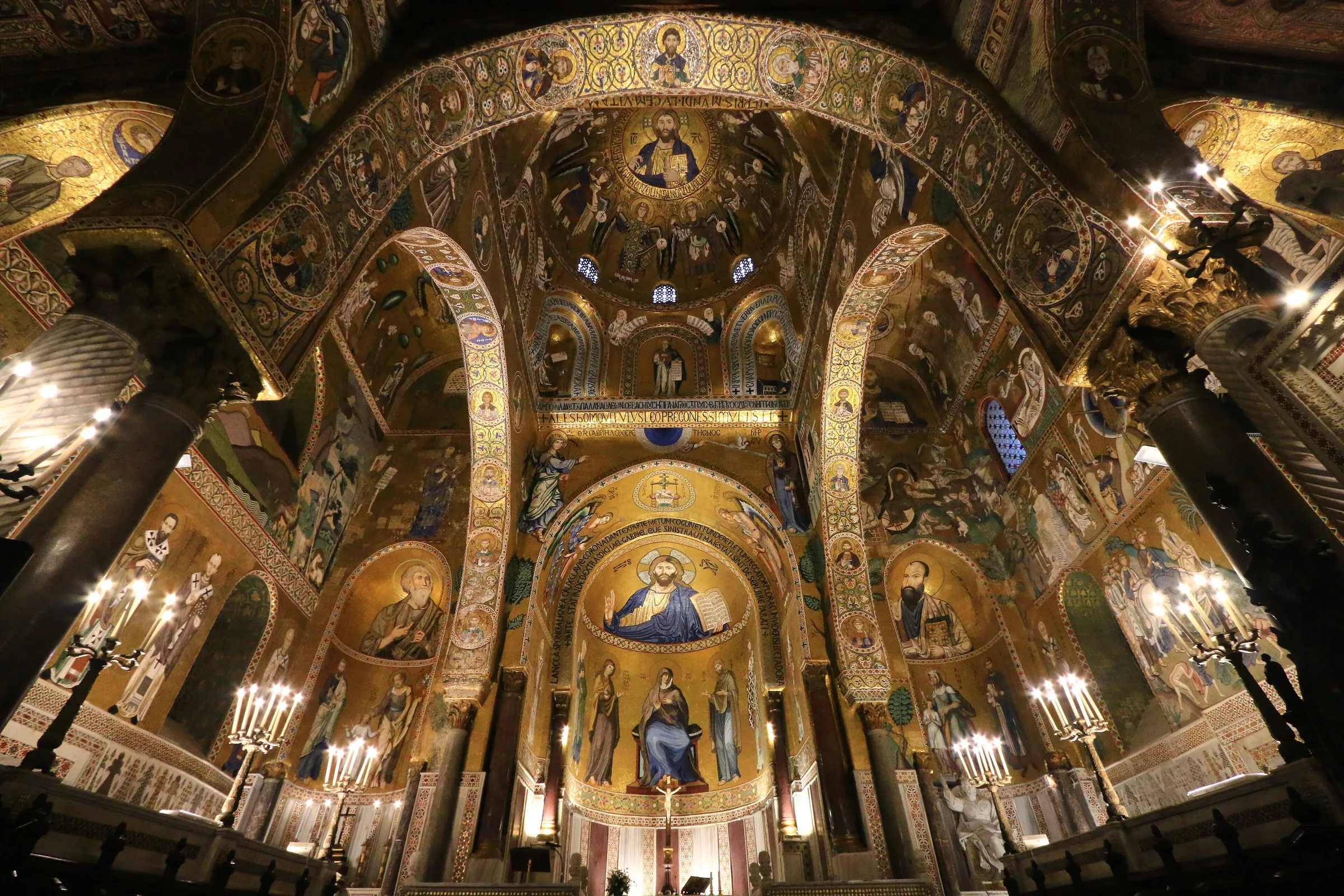
歐洲最古老的皇家住所,從布匿時期的石牆到諾曼時期的金碧輝煌層層堆疊,而帕拉提納禮拜堂正是這座宮殿的核心所在。
巴勒摩諾曼宮是歐洲最古老的皇家住所,帕拉提納禮拜堂在其上層閃耀著光芒。以下說明整座宮殿的空間配置,以及如何規劃一趟參觀行程。
歐洲最古老的皇家住所
Set on the highest ground of old Palermo, near the Porta Nuova and the Piazza del Parlamento, the Palazzo dei Normanni is the oldest royal residence in Europe. That is not a marketing flourish but a plain fact of continuity: kings, viceroys and now parliamentarians have governed Sicily from this exact hill for the better part of a thousand years, and the building has never fully stopped being a seat of power. Most visitors arrive knowing it as the home of the Cappella Palatina, the dazzling royal chapel commissioned by King Roger II, whose construction began in 1132 and which was consecrated in 1140. The chapel sits on the piano nobile, the noble upper floor, and it remains the reason most people climb the hill. Yet the chapel is one jewel in a much larger setting. The palace is a working building today: it houses the Sicilian Regional Assembly, and the chamber where the island's laws are debated occupies rooms only a corridor or two from the Byzantine mosaics. That living function shapes what you can see and when, because the parts of the palace given over to government are not always open to the public. Approaching it, you feel the layers before you read a single label. The lower walls are heavy and defensive, the product of an age when this was a stronghold; the upper floors are lighter, more courtly, the work of centuries of ceremonial life. Understanding the Palazzo dei Normanni as a whole, rather than as a single famous chapel, is the key to a satisfying visit, and it explains why the ticket, the opening days and the route through the rooms all reward a little planning before you arrive.
一座層層疊疊的宮殿:布匿、羅馬、阿拉伯、諾曼、西班牙
Few buildings in Europe hold their history as visibly as this one. Dig beneath the courtyards and you reach Punic and Roman foundations, the earliest stone laid when the hill first became a fortified site above the harbour. On those foundations, rulers of Arab Palermo raised a fortress, using the elevated ground to command the city and the plain beyond. When the Normans took the island in the eleventh century, they did not tear the stronghold down; they adopted it, enlarged it and turned a military citadel into a royal palace, adding the grand halls, the chapel and the towers that gave the complex its courtly character. This is why the Palazzo dei Normanni feels simultaneously like a castle and a court. Later still, under Spanish viceregal rule, the palace was remodelled again for a new kind of ceremony. Grand staircases, a monumental courtyard with tiered loggias, and reworked state rooms gave the building the more formal, Renaissance-and-Baroque face that greets you from the main square today. Each era left its grammar in the fabric: thick defensive masonry from the Arab and early Norman phases, golden mosaic and honeycombed ceilings from the Norman court at its height, and the ordered arcades and staircases of the viceregal age. Walking the circuit, you are really reading a timeline written in stone, marble and gold, and the pleasure of the place lies in noticing where one century hands over to the next. This depth of history is part of why the surrounding district, the Arab-Norman heart of Palermo, carries such weight, and why the chapel at the palace's core is considered the supreme surviving statement of the cultures that met and merged on this hill.
皇家寓所與羅傑廳
Above the chapel lie the Royal Apartments, the Appartamenti Reali, sometimes called the Sale Reali. These are the ceremonial state rooms of the palace, refined and redecorated across the Norman, Spanish and later periods, and they show a very different face of royal life from the sacred hush of the chapel. Frescoed halls, painted ceilings, portraits and long enfilades of connected rooms speak of court ritual, audiences and government rather than worship. The undisputed highlight is the Sala di Ruggero, Roger's Hall, one of the oldest surviving decorated rooms in the palace. Its walls and vaults carry secular mosaics, a rarity in a medieval world where gold mosaic was almost always reserved for religious subjects. Instead of saints, the tesserae here depict hunting scenes and a stylised paradise garden: leopards and lions, peacocks, deer, archers and centaurs set among palm trees and symmetrical foliage, all worked in the same shimmering Byzantine technique used in the chapel below. The effect is worldly and playful, a glimpse of the pleasures and imagery a Norman king surrounded himself with in his private quarters. Seeing Roger's Hall alongside the Cappella Palatina completes the picture of the court that made both: the same artisans, the same taste for glittering surfaces, applied once to the divine and once to the delights of the hunt. Because these rooms are still bound up with the life of the palace, they follow their own opening pattern rather than the chapel's, and this is where visitors most often trip up. If seeing the Royal Apartments and Roger's Hall matters to you, the day you choose for your visit is not a detail; it decides whether these rooms are open at all, as the next section explains.
每位遊客都該知道的週五至週一注意事項
Here is the single most important piece of planning information for the Palazzo dei Normanni, and it is easy to miss. The Royal Apartments, the Sale Reali including Roger's Hall, are only open to visitors from Friday to Monday. From Tuesday to Thursday they are closed, because the palace's governing life takes priority in those rooms during the working week. Crucially, the ticket price does not change on the days when the apartments are shut. If you visit on a Tuesday, Wednesday or Thursday, you pay the same amount but you see a chapel-focused version of the palace: the Cappella Palatina, the gardens, the archaeological area and the exhibition spaces, but not the state rooms upstairs. This catches out a great many travellers who assumed a royal palace would show its royal apartments every day. So decide first what you most want to see. If the mosaics of Roger's Hall and the full ceremonial suite are on your list, plan your visit for a Friday, Saturday, Sunday or Monday, and treat the chapel as the crowning part of a longer circuit. If your heart is set purely on the Cappella Palatina, any open day will serve you well, and a midweek visit can be quieter. What we will never do is promise you the Royal Apartments on a day they are closed. When we arrange your dated entry, we secure admission to the palace for the date you choose; the parts open on that date depend on the day of the week, not on the ticket. Choosing a Friday-to-Monday date is the only way to guarantee the apartments form part of your visit, so build your itinerary around that fact rather than discovering it at the threshold.
一張門票,走遍全程
A visit to the Palazzo dei Normanni is a circuit rather than a single room, and the combined admission ticket is designed to reflect that. One dated ticket covers the Cappella Palatina, the Royal Apartments, the Royal Gardens, the permanent exhibition and the archaeological area beneath the palace, subject to the Friday-to-Monday rule for the apartments. Entry is date-based: your ticket is valid for the day you choose rather than a fixed minute-by-minute time slot, which gives you welcome flexibility to move through the spaces at your own pace. We are a concierge service that books and arranges that dated entry on your behalf, so you arrive with your admission already secured for the date you have planned around. Our per-person prices are straightforward and shown on the booking page: a full adult admission; a reduced rate for EU citizens aged 18 to 25 and teachers; a senior rate for EU seniors aged 65 and over; and a youth rate for ages 14 to 17. Children under 13 enter free, though they must be accompanied by a paying adult. Visitors with a disability, together with one companion, also enter without charge. If you are claiming a reduced, senior or youth rate, carry valid identification or proof of eligibility, because it is checked at entry and the rate depends on it. An audioguide is available on site for a small additional fee if you would like the rooms narrated as you go. As with most cultural admissions of this kind, sales are final; a refund applies only in the event that entry cannot be honoured on the operator's side. Booking the dated ticket in advance simply means the admission is arranged and waiting, so your day in Palermo begins at the chapel door rather than in a queue for it.
皇家花園與周邊環境
Do not rush straight out after the chapel. The Palazzo dei Normanni is wrapped by the Royal Gardens, a green terrace on the palace flank that is included in the same combined ticket and makes a natural pause between the intensity of the mosaics and the noise of the city below. Laid out on the slopes around the old fortress walls, the gardens mix palms, subtropical planting and shaded paths with long views over Palermo toward the sea, a reminder of why rulers chose this commanding hill in the first place. After the gold-lit interiors, the open sky and greenery reset the eye, and they turn a chapel visit into a half-day rather than a quick stop. The palace's position also makes it the anchor of a wonderful walking itinerary. It stands roughly a fifteen-to-twenty-minute walk uphill from Palermo Cathedral along Corso Vittorio Emanuele, close to the great gateway of the Porta Nuova, so the two monuments pair easily in a single morning. Immediately beside the palace are the red domes of San Giovanni degli Eremiti, another gem of the Arab-Norman city and an obvious next stop. From there the rest of the old town opens up: the Quattro Canti crossroads, the Teatro Massimo, the Ballaro market and, a short trip out of the centre, the golden mosaics of Monreale, which share the same artistic world as the Cappella Palatina. City buses serve the nearby Piazza Indipendenza, and from Palermo Airport the palace is reachable in roughly thirty-five to forty-five minutes using the airport train or shuttle followed by local transport. Treat the palace as the high point of a day spent in the Arab-Norman quarter, and the gardens as the place to sit and let it all settle.
選擇合適的日期與時段
Timing shapes a visit to the Palazzo dei Normanni almost as much as the ticket itself, so it pays to think about the calendar and the clock together. The palace opens for visitors from roughly half past eight in the morning. From Monday to Saturday the day runs long, with last admission in the late afternoon, around half past four, which leaves plenty of room to linger over the chapel and, on the right days, the state rooms above. Sundays and religious holidays are different and shorter: the last admission falls around midday, so a Sunday visit needs an earlier start to avoid disappointment at the door. There is one more Sunday-and-holiday quirk worth writing into your plans. Because the Cappella Palatina is a consecrated royal chapel, it closes to visitors between roughly a quarter to ten and a quarter past eleven in the morning on Sundays and religious holidays for Mass. If you arrive during that window you will not be able to enter the chapel, so aim either for the short slot right at opening or for the period after the service. Layer these hours on top of the Friday-to-Monday rule for the Royal Apartments and a clear picture emerges. The richest possible visit is a Friday, Saturday or Monday, arriving near opening, when the apartments and Roger's Hall are open and the chapel is available all day. A Sunday can still be rewarding but demands an early, Mass-aware start and a briefer overall window. Midweek, from Tuesday to Thursday, gives you a calm, chapel-centred visit with the gardens and archaeological area, but no state rooms. Whichever date suits your trip, we arrange your dated entry in advance so admission is secured for the day you choose, and you can build the rest of your Palermo itinerary around a firm starting point rather than a hopeful one.
常見問題
皇家寓所每天都有開放嗎?
不是。皇家寓所(包括 Roger's Hall)僅於週五至週一開放。週二至週四關閉,且票價維持不變,因此週中造訪以禮拜堂為重點。若想參觀國事廳,請選擇週五、週六、週日或週一的日期。
聯票包含哪些內容?
一張指定日期的門票涵蓋 Cappella Palatina、皇家寓所、皇家花園、常設展覽及考古區。皇家寓所僅在週五至週一納入參觀範圍;其他日期,同一張票仍可進入其餘參觀路線。
這座宮殿目前仍作為政府用途嗎?
是的。Palazzo dei Normanni 是西西里區域議會的所在地,因此它既是古蹟,也是實際運作的政府場所。正因如此,皇家寓所才採用週五至週一的獨立開放模式,而非每天開放。
我應該預留多少時間?
建議預留約兩小時,才能好好欣賞這座宮殿。Cappella Palatina 值得細細品味,而週五至週一開放的皇家寓所與 Roger's Hall 會大幅增加參觀路線的豐富度。若再加上花園與考古區,輕鬆就能填滿一個悠閒的半日行程。
優待票與敬老票需要出示證明嗎?
需要。優待、敬老及青年票價皆須符合資格條件,請於入場時攜帶有效身分證明或相關文件。18 至 25 歲的歐盟公民及教師可享優待票,65 歲以上歐盟長者可享敬老票,14 至 17 歲青少年可享青年票。13 歲以下兒童可由成人陪同免費入場。