 Coupe-file disponible
 Au cœur des mosaïques dorées de la Cappella Palatina
Comment Roger II a fusionné l’or byzantin, les caissons de bois islamiques et le design latin en une seule chapelle royale éblouissante — et comment déchiffrer chaque détail lors de votre visite.
Peu de salles en Europe récompensent autant la contemplation lente que la Cappella Palatina. Sous un plafond à la fois mosaïque chrétienne et boiserie islamique, trois cultures se rencontrent dans une chapelle royale normande à Palerme.
Roger II et la chapelle qu’il fit bâtir pour régner
La Cappella Palatina fut conçue comme un instrument de la royauté. Le roi Roger II, qui avait réuni en 1130 les terres disparates du sud de l'Italie et de la Sicile en un seul royaume normand, avait besoin d'une chapelle royale qui parle à tous les peuples qu'il gouvernait — les chrétiens de langue grecque, les musulmans de langue arabe et l'Occident latin. La construction débuta en 1132 à l'étage supérieur du Palazzo dei Normanni, et la chapelle fut consacrée en 1140, bien que son décor de mosaïques se soit poursuivi durant les années 1140 et au-delà.
Ce que Roger commanda n'était pas un compromis, mais une déclaration délibérée. Il fit venir des mosaïstes byzantins formés dans les ateliers de l'Empire d'Orient, des artisans fatimides du Méditerranée islamique experts en bois sculpté et peint, et des bâtisseurs latins qui tracèrent le plan d'une basilique occidentale. Le résultat plaça l'imagerie sacrée de Constantinople sous un plafond qui n'aurait pas déparé au Caire, le tout au sein d'un espace liturgique chrétien.
La chapelle servait aussi directement la couronne. Une estrade surélevée à l'extrémité ouest marquait la place du roi, positionnant le souverain dans un théâtre doré d'autorité divine. Se tenir là où Roger se tenait, c'est saisir la logique politique de la pièce : un roi normand, couronné dans un royaume métissé, se présentant comme le point de rencontre des trois grandes civilisations de son temps. Le génie de la chapelle tient à ce que cette ambition ne se lit jamais comme un encombrement. Chaque surface — murs, voûtes, plafond, sol — appartient à une vision cohérente, exécutée avec une assurance que seule une cour riche et sûre d'elle pouvait s'offrir. Près de neuf siècles plus tard, la Cappella Palatina demeure l'expression la plus limpide de ce que la Sicile normande croyait être.
Le programme de mosaïques dorées : deux images du Christ
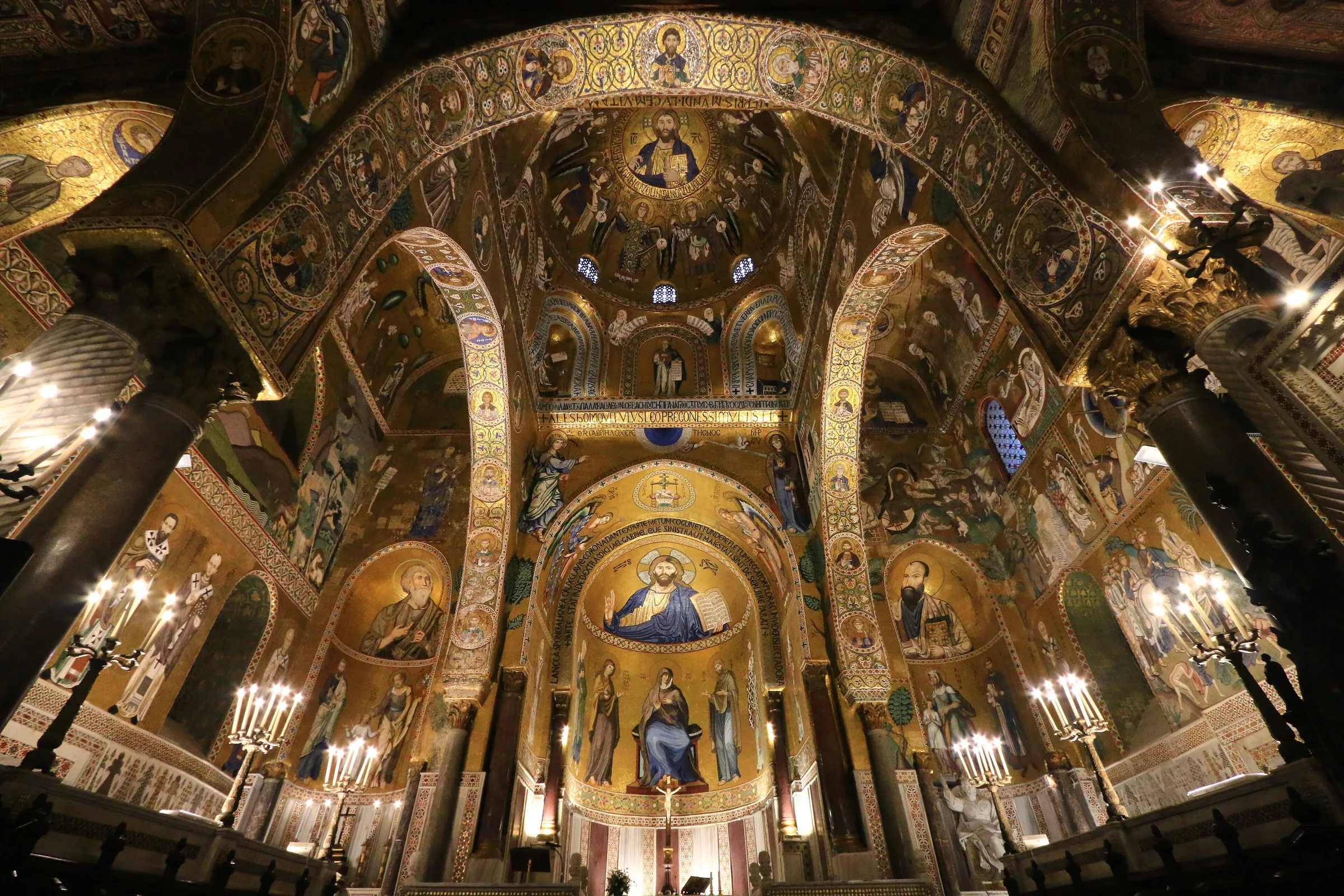
Dès que l’on franchit le seuil, la première sensation est celle de la lumière. Les parois supérieures, les arcs et les voûtes sont revêtus de mosaïques posées sur un fond d’or, composées de minuscules tesselles de verre doublées de feuille d’or et inclinées de manière à capter et à diffuser la lueur des bougies et des fenêtres. L’effet recherché par les artistes byzantins n’était pas décoratif mais transformateur : le visiteur doit se sentir soulevé hors du monde ordinaire pour pénétrer dans un paradis doré.
Le programme est rythmé par deux grandes images du Christ. Dans la coupole au-dessus du sanctuaire règne le Christ Pantocrator — le Christ « Maître de toutes choses » — la main droite levée en bénédiction, un livre dans la main gauche, le regard fixe et éternel, entouré d’archanges et d’anges. Un second Pantocrator occupe la demi-coupole de l’abside centrale, présidant l’autel en contrebas, si bien que le fidèle rencontre deux fois la même figure souveraine tandis que le regard parcourt l’extrémité sacrée orientale.
Autour de ces images centrales se déploie toute une hiérarchie céleste. Des rangées d’anges et d’archanges entourent la coupole. Prophètes et évangélistes occupent les transitions entre surfaces courbes et planes, leurs noms inscrits, souvent en grec, témoignant de la main byzantine à l’œuvre. Des saints debout — évêques, guerriers, moines et diacres — bordent les murs dans des poses frontales solennelles, leurs auréoles d’or se fondant dans le champ doré qui les entoure.
Le savoir-faire récompense l’observation attentive. Les visages sont modelés dans des tons de verre gradués, les drapés tombent en plis linéaires assurés, et la légère irrégularité des tesselles posées à la main confère aux surfaces un scintillement vivant qu’aucune peinture plane ne saurait égaler. C’est la mosaïque byzantine à son apogée, réalisée loin de Constantinople mais pleinement dans sa tradition, qui transforme toute la chapelle supérieure en une vision continue et unique de l’ordre divin.
Lire les cycles bibliques sur les murs
Sous et autour des grandes figures du Christ, des saints et des anges, les mosaïques racontent des histoires. Les murs de la Cappella Palatina portent de vastes cycles narratifs tirés des Écritures, agencés de telle sorte qu'un visiteur parcourant la chapelle lit littéralement l'histoire sacrée du monde, écrite en or.
La nef dévoile des scènes de l'Ancien Testament, depuis la Création et les premiers chapitres de la Genèse. Le récit se déploie à travers la fabrique du monde, la formation et la chute de l'humanité, Noé et le Déluge, puis les histoires des patriarches — chaque épisode condensé en un tableau lisible, avec ses figures, son paysage et ses inscriptions. Cette ampleur cumulative confère à la nef le caractère d'un livre illustré dont on tourne les pages en marchant.
Dans les parties orientales de la chapelle, plus près de l'autel, l'accent se déplace vers le Nouveau Testament et la vie du Christ — les grandes fêtes et miracles que les églises byzantines plaçaient traditionnellement près du sanctuaire. Ailleurs, les cycles honorent les apôtres Pierre et Paul, dont les voyages missionnaires et les actes sont relatés en séquences propres, reflétant les liens de la chapelle avec l'Église d'Orient comme avec la Rome latine.
Ce qui rend ces cycles si satisfaisants, c'est leur clarté. Les concepteurs ont compris qu'un spectateur au niveau du sol devait saisir chaque scène rapidement : les gestes sont amples, les compositions aérées, et le fond d'or isole chaque figure. La couleur est employée avec parcimonie et à dessein — une robe bleu profond, un éclat de vermillon — contre la dominante dorée. Lu avec patience, le mur révèle une théologie savamment ordonnée : la Création et la Chute dans le corps de la chapelle, la rédemption rassemblée vers l'autel, et la mission de l'Église portée au-dehors par ses saints. Prenez le temps, et laissez l'œil suivre le récit plutôt que d'admirer seulement le scintillement.
Le plafond peint à muqarnas : l’islam au-dessus
Puis vous levez les yeux, et la chapelle change entièrement de caractère. Au-dessus de la nef s'étend un plafond de bois en muqarnas — cette voûte en nid d'abeille, ou en stalactites, l'une des formes emblématiques de l'architecture islamique. Taillé et assemblé en bois plutôt qu'en pierre, il descend en rangées successives de petites niches, de pendentifs et d'alvéoles en étoile, une cascade géométrique qui semble flotter au-dessus de la chapelle chrétienne comme un dais venu d'un autre monde.
Ce plafond est l'œuvre d'artisans formés à l'école fatimide, et il introduit le vocabulaire artistique de la Méditerranée islamique au cœur même d'une fondation royale normande. Ses surfaces ne sont pas laissées nues, mais richement peintes. Parmi l'ornementation géométrique et végétale d'une grande complexité se déploie un programme d'imagerie courtoise : figures en plein loisir et en célébration, buveurs et musiciens, danseurs, chasseurs, animaux et oiseaux, disposés dans les petites facettes du nid d'abeille. C'est l'iconographie profane et hédoniste d'une cour princière, la même culture visuelle que l'on retrouve à travers tout le monde islamique médiéval.
Le résultat est l'un des plus remarquables juxtapositions de tout l'art médiéval. Une chapelle chrétienne, dont les murs sont revêtus d'or byzantin, est couronnée d'un plafond islamique peint de délices terrestres — et les deux ne s'opposent pas. Les concepteurs de Roger les ont mis en dialogue : l'ordre sacré s'élève le long des murs et la splendeur courtoise voûte la nef, tous deux au service du même mécène royal.
Parce que les scènes peintes sont petites et hautes, elles récompensent la patience et, idéalement, un lent balayage du regard sur toute la longueur du plafond. Une grande partie des plus belles peintures anciennes de la Méditerranée islamique a mal survécu ailleurs ; ici, elles perdurent, abritées au sein d'une chapelle toujours en usage. Debout sous les muqarnas, vous contemplez une survivance rare et précieuse — l'art courtois fatimide préservé par un roi chrétien.
Sols cosmatesques, ambon et chandelier pascal
La splendeur de la Cappella Palatina ne s'arrête pas aux mosaïques. Baissez les yeux : le sol est à lui seul un chef-d'œuvre. Un pavement cosmatesque, cette technique de marqueterie de marbre où de petits fragments de pierres colorées — porphyre, serpentine, marbres précieux, certains sauvés de monuments romains bien plus anciens — sont taillés et disposés en motifs géométriques tourbillonnants de cercles, de bandes et d'entrelacs. Les murs inférieurs reprennent le même traitement, habillés de panneaux de marbre poli et d'incrustations, si bien que toute la zone basse de la chapelle rayonne d'une richesse minérale plus sourde, sous le feu doré qui embrase les hauteurs.
Ce marbre rubané et ornementé relevait d'une tradition romaine et italienne, et sa présence complète l'équation culturelle de la chapelle : la pierre latine en bas, la mosaïque byzantine sur les murs, le bois islamique au plafond. Le regard s'élève de la terre au ciel à travers trois langages artistiques distincts.
Deux éléments du mobilier méritent une attention particulière. S'élevant près du sanctuaire, l'ambon de marbre — la chaire d'où les Écritures étaient proclamées — plateforme surélevée portée par de fines colonnes, ornée des mêmes incrustations de marbre et de mosaïque qui unifient la chapelle. À ses côtés se dresse le grand candélabre pascal, une haute colonne de marbre sculpté qui portait le cierge de Pâques. Son fût est travaillé d'un relief dense où s'entrelacent figures, feuillages, animaux et motifs bibliques qui grimpent vers la flamme — une pièce virtuose de sculpture romane qui mérite qu'on en fasse lentement le tour.
Ensemble, le sol, l'ambon et le candélabre révèlent que la chapelle fut conçue comme une œuvre d'art totale, où aucune surface, aucun objet ne fut laissé à l'ordinaire. Même les accessoires de la liturgie — le lieu de la prédication, la lumière de Pâques — furent élevés au rang de sculpture. Apprécier pleinement la Cappella Palatina, c'est accorder au marbre autant d'attention qu'à l'or.
Trois cultures, un chef-d’œuvre : pourquoi l’UNESCO l’a inscrit
Ce qui émeut le plus profondément le visiteur de la Cappella Palatina, ce n'est aucun élément pris isolément, mais la fusion de tous. Nulle part ailleurs les traditions artistiques byzantine, islamique et latine ne se trouvent réunies avec une telle plénitude, une telle précocité et une telle harmonie dans un espace aussi restreint. La chapelle est la preuve tangible d'un moment bref et extraordinaire où la Sicile normande gouvernait une société résolument plurielle et choisissait d'exprimer cette pluralité dans la pierre, le verre et le bois doré.
Chaque tradition conserve sa propre voix. Les mosaïques sont indiscutablement byzantines, jusque dans leurs inscriptions grecques et le regard fixe du Pantocrator. Le plafond à muqarnas est indiscutablement islamique, tant par sa forme que par son imagerie courtoise peinte. Le plan et le marbre cosmatesque sont latins et italiens. Pourtant, une seule volonté royale les a liés en une pièce cohérente, et les jointures, loin d'être des défauts, sont précisément l'essentiel. La chapelle ne fond pas les trois cultures en un tout indistinct ; elle les maintient ensemble en dialogue, chacune enrichissant les autres.
C'est pourquoi, en 2015, la Cappella Palatina a été inscrite sur la liste du patrimoine mondial de l'UNESCO au titre de « Palerme arabo-normande et les cathédrales de Cefalù et Monreale ». Cette inscription reconnaît tout un ensemble de monuments à Palerme et ses environs qui incarnent cette même synthèse, et la chapelle palatine en est le joyau — l'expression la plus concentrée et la mieux préservée de la culture arabo-normande-byzantine qui s'épanouit sur l'île au XIIe siècle.
Visiter, c'est assister à une voie que la majeure partie de l'Europe médiévale n'a pas empruntée : une cour qui traitait les réalisations artistiques de trois confessions comme des trésors à recueillir, et non comme des rivales à fuir. Cette ouverture, rendue éternelle dans l'or et le bois peint, est ce qui confère à la Cappella Palatina sa puissance durable — et ce qui fait qu'y pénétrer ressemble moins à une visite touristique qu'à un voyage dans le temps.
Admirer les mosaïques dans les meilleures conditions lors de votre visite
La Cappella Palatina récompense la préparation, car sa gloire réside dans le détail et la lumière. Efforcez-vous d’arriver avec du temps devant vous et, si possible, lorsque la chapelle est plus calme — tôt dans la journée, elle a tendance à être plus tranquille, et la lumière rasante et basse peut faire scintiller les tesselles d’or avec une intensité particulière. Accordez-vous suffisamment de temps pour lever les yeux vers les muqarnas, baisser le regard vers le sol cosmatesque et parcourir lentement les cycles bibliques, plutôt que de traverser en quelques minutes.
Un court audioguide officiel est disponible pour un petit supplément et vous aide à repérer les deux images du Christ Pantocrator, à suivre le récit de la Genèse le long de la nef et à distinguer les figures courtoises peintes au plafond. Même sans lui, un plan d’approche simple aide : lisez les murs d’est en ouest comme une histoire, puis reculez-vous et embrassez l’ensemble de l’enveloppe dorée comme une seule composition.
Nous sommes un service de concierge qui organise et garantit votre entrée à l’avance pour la date choisie, afin que vous puissiez vous concentrer sur l’art plutôt que sur la logistique. L’entrée est valable à la date que vous sélectionnez plutôt qu’à une heure fixe, ce qui vous offre une flexibilité appréciable autour d’une matinée de visites dans le quartier du palais normand. Si vous bénéficiez d’un tarif réduit, senior ou jeune, munissez-vous d’une pièce d’identité valide ou d’un justificatif ouvrant droit à ce tarif, car il devra être présenté à l’entrée.
Quelques notes de timing façonnent la journée. La chapelle ferme aux visiteurs les dimanches et les matins de jours fériés religieux, environ de 09:30 à 11:30, pour la messe, et ces jours-là ont des horaires globalement plus courts. Les Appartements royaux attenants, avec leurs mosaïques profanes de chasse, ne sont ouverts que du jeudi au lundi ; prévoyez donc une visite du jeudi au lundi si vous souhaitez voir ces salles également. Dans tous les cas, les mosaïques de la chapelle elle-même sont la raison de venir.
Questions fréquentes
Qui a fait construire la Cappella Palatina et quand ?
Elle fut commandée par le roi Roger II, premier roi normand de Sicile. La construction débuta en 1132 dans le Palazzo dei Normanni à Palerme, et la chapelle fut consacrée en 1140. Ses mosaïques dorées furent réalisées au fil des années 1140 et des décennies suivantes, faisant d'elle la chapelle royale de Roger et une affirmation de son règne.
De quoi est fait le plafond en muqarnas et pourquoi est-il si particulier ?
Le muqarnas est un plafond en nid d'abeilles, ou en stalactites, construit en bois sculpté et peint par des artisans formés à l'école fatimide. Il surplombe la nef en étages de petites niches ornées de scènes de cour — musiciens, chasseurs, animaux et figures au loisir. Cet art islamique rare, préservé au sein d'une chapelle chrétienne, en fait l'un des plus grands trésors de l'édifice.
Quelles sont les deux images du Christ dans la chapelle ?
La Cappella Palatina abrite deux mosaïques byzantines du Christ Pantocrator, signifiant « Souverain de toutes choses ». L'une remplit la coupole au-dessus du sanctuaire, entourée d'anges, et une seconde préside l'abside centrale au-dessus de l'autel. Rencontrer deux fois cette même figure imposante en regardant vers l'est est au cœur de la conception de la chapelle.
Pourquoi la Cappella Palatina est-elle un site du patrimoine mondial de l'UNESCO ?
En 2015, elle a été inscrite au titre de « Palerme arabo-normande et les cathédrales de Cefalù et Monreale ». Cette inscription reconnaît la fusion des cultures byzantine, islamique et latine sous la domination normande. La chapelle en est l'exemple le plus raffiné et le mieux préservé, réunissant en un seul espace mosaïques dorées, plafond islamique en muqarnas et marbre cosmatesque.
La chapelle est-elle parfois fermée aux visiteurs pendant la journée ?
Oui. Les dimanches et jours fériés religieux, la chapelle ferme aux visiteurs pour la messe, environ de 09h30 à 11h30, et ces jours ont des heures globalement plus courtes avec une dernière admission plus précoce. Pour voir les mosaïques dans leur plus grand calme, une arrivée en semaine plus tôt dans la journée est souvent le moment le plus gratifiant pour visiter.