 Coupe-file disponible
 Palerme arabo-normande : un itinéraire autour de la Chapelle
Comment construire un itinéraire d'un ou deux jours à Palerme autour de la Cappella Palatina, en passant par les mosaïques dorées, les coupoles rouges et les cathédrales du circuit UNESCO.
La Cappella Palatina est le joyau au cœur de l'un des grands circuits culturels de Sicile. Voici comment la combiner avec les autres sites arabo-normands de Palerme en un seul voyage rythmé et équilibré.
Le circuit UNESCO de 2015 et ce qu'il englobe
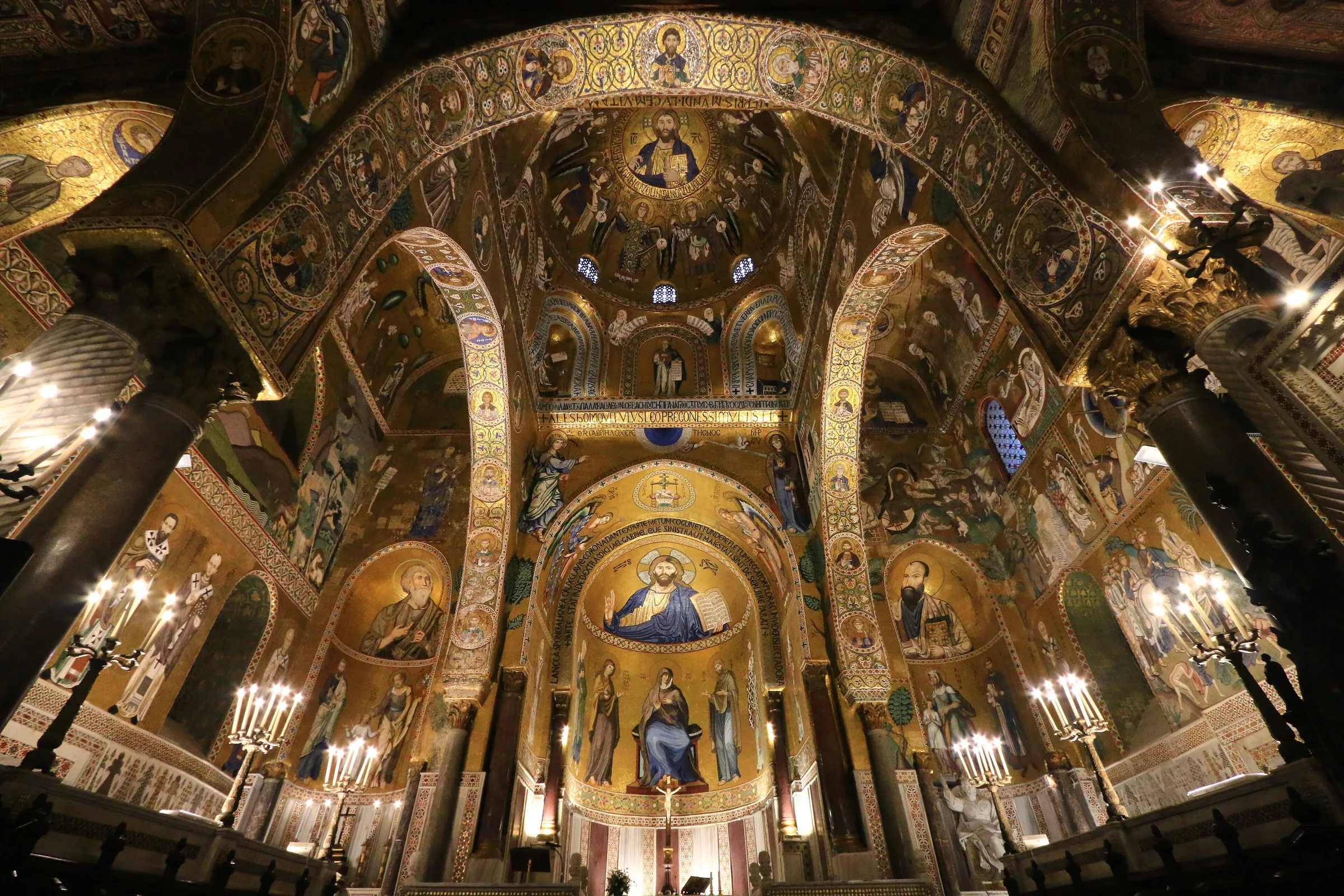
En 2015, l'UNESCO a inscrit un ensemble de monuments de Palerme sur la Liste du patrimoine mondial sous un intitulé unique : « Palerme arabo-normande et les cathédrales de Cefalù et de Monreale ». Il ne s'agit pas d'un seul édifice, mais d'un réseau de neuf sites, répartis dans la ville et deux bourgs voisins, tous issus du royaume normand de Sicile du XIIe siècle. Ce qui les unit, c'est un langage visuel commun : la technique de la mosaïque byzantine, l'artisanat et l'ornementation islamiques, et l'architecture romane occidentale, fusionnés en quelque chose qui n'existait nulle part ailleurs. La Chapelle Palatine, chapelle royale située au piano nobile du Palais des Normands, est l'expression suprême de cette synthèse et le point d'ancrage naturel de tout itinéraire. Commandée par le roi Roger II, commencée en 1132 et consacrée en 1140, elle réunit sous un même toit des mosaïques dorées sur les murs et les voûtes, un plafond en muqarnas de bois peint de style fatimide, des marbres incrustés cosmatesques et un plan de basilique latine. Les autres sites inscrits prolongent cette même histoire vers l'extérieur. À Palerme même, ils comprennent le palais lui-même, la cathédrale de Palerme, les églises San Giovanni degli Eremiti, San Cataldo, Santa Maria dell'Ammiraglio (la Martorana), la petite église San Giovanni dei Lebbrosi, et le palais de plaisance connu sous le nom de Zisa, ainsi que le pont voûté de l'Ammiraglio. Au-delà de la ville se dressent les deux grandes cathédrales qui complètent l'intitulé : Monreale, au-dessus de la Conca d'Oro, et Cefalù, sur la côte à l'est. Comprendre le parcours de cette manière vous aide à planifier. Vous n'avez pas besoin de voir les neuf sites pour saisir le thème, mais une belle visite de Palerme traite la chapelle comme le centre et rayonne vers deux ou trois autres sites, en choisissant selon la proximité et la quantité de mosaïques que vous souhaitez absorber en une journée. Les sections ci-dessous regroupent les sites selon leur facilité à s'associer à une visite de la chapelle, afin que vous puissiez composer un itinéraire adapté à votre rythme plutôt que de courir après une liste à cocher.
Juste à côté : San Giovanni degli Eremiti et les abords du palais
Les ajouts les plus faciles à une visite de la chapelle sont ceux que vous pouvez rejoindre à pied en quelques minutes, et le plus proche de tous est San Giovanni degli Eremiti. Son ensemble de dômes rouges bulbeux, s'élevant juste en contrebas du Palazzo dei Normanni, est l'une des silhouettes les plus photographiées de Palerme et un raccourci du caractère arabo-normand de la ville. Les dômes sont d'une forme indéniablement islamique, posés sur une sobre église normande, et le cloître et le jardin tranquilles à côté constituent un contrepoint paisible à la densité des mosaïques de la chapelle. Parce qu'il est si proche du palais, il s'intègre naturellement à la même demi-journée sans aucun transport. Avant de quitter le palais lui-même, accordez du temps à ce que votre billet de chapelle peut inclure au-delà de la chapelle. Du jeudi au lundi, l'admission combinée couvre la Chapelle Palatine ainsi que les Appartements Royaux, les Jardins Royaux, l'exposition permanente et la zone archéologique. Les Appartements Royaux, ou Sale Reali, sont le point fort de cette visite élargie : ils abritent la Sala di Ruggero, la Salle de Roger, décorée de mosaïques profanes de scènes de chasse, de paons et de léopards qui montrent les mêmes ateliers mettant leur savoir-faire au service de sujets profanes plutôt que sacrés. Il y a un point important à anticiper. Les Appartements Royaux n'ouvrent que du jeudi au lundi ; le mardi et le mercredi, ils sont fermés et la visite se limite à la chapelle et aux Jardins Royaux, tandis que notre prix reste le même quel que soit le jour choisi. Si voir la Sala di Ruggero compte pour vous, privilégiez une fenêtre du jeudi au lundi. Le Palazzo dei Normanni est lui-même la plus ancienne résidence royale d'Europe et sert encore de siège à l'Assemblée Régionale Sicilienne, si bien que certaines parties du complexe sont des espaces gouvernementaux en activité plutôt qu'un musée. Combiner la chapelle, les appartements, les jardins et San Giovanni degli Eremiti vous offre une matinée compacte, entièrement à pied, construite autour d'une seule entrée à billet.
Une courte descente à pied : la cathédrale de Palerme et le centre historique
Depuis le palais, la suite logique est de descendre vers le cœur de la vieille ville. La cathédrale de Palerme se trouve à environ quinze à vingt minutes à pied le long du Corso Vittorio Emanuele, cet axe cérémoniel rectiligne qui longe la Porta Nuova, juste à côté du palais. La cathédrale fait partie de la même inscription UNESCO et récompense amplement cette courte promenade : sa longue façade est un véritable palimpseste des souverains qui ont gouverné la ville, mêlant la structure normande à des ajouts gothiques, catalans et baroques, ainsi qu'un dôme ajouté des siècles après sa fondation. Cherchez du regard la colonne réemployée près du porche sud, ornée d'une inscription coranique — un fragment littéral de la Palerme islamique enchâssé dans une cathédrale chrétienne, et une parfaite illustration de la raison d'être de cet itinéraire. À l'intérieur, l'atmosphère est tout autre que celle de la chapelle : plus fraîche, plus dépouillée, monumentale plutôt que précieuse, avec les tombeaux royaux et impériaux des souverains médiévaux de Sicile réunis dans le porphyre. En poursuivant sur la même artère, vous arrivez aux Quattro Canti, ce carrefour baroque octogonal où se rejoignent les quatre quartiers historiques de Palerme, et à quelques pas de là, la Piazza Pretoria et sa fontaine foisonnante. C'est aussi la porte d'entrée de la Martorana et de San Cataldo, sur la toute proche Piazza Bellini, deux autres églises inscrites au patrimoine : la Martorana conserve certaines des plus anciennes mosaïques byzantines de Sicile, et San Cataldo arbore les mêmes coupoles rouges que San Giovanni degli Eremiti. En reliant ces joyaux les uns aux autres, la visite de la cathédrale cesse d'être une simple étape isolée pour devenir une lente descente à travers la ville médiévale, monument après monument, le tout dans un périmètre de marche très compact. Parce que le corso relie si directement le palais à la cathédrale, ce duo constitue l'épine dorsale de la plupart des programmes d'une journée. Faites-le dans le sens qui convient à votre emploi du temps : la chapelle en premier, puis la descente vers la cathédrale et les Quattro Canti pour le déjeuner, ou l'inverse si vous préférez rejoindre le palais pour une fin de matinée plus paisible. Dans les deux cas, la marche est aisée et se déroule presque entièrement le long d'une seule rue mémorable.
L'excursion qui vaut le détour : Monreale et Cefalù
Les deux sites qui donnent son nom complet au titre UNESCO se trouvent aux abords de Palerme, et tous deux méritent le détour pour qui succombe aux mosaïques de la chapelle. La cathédrale de Monreale est la plus proche des deux, juchée sur les hauteurs surplombant la ville à une vingtaine de minutes, accessible en bus local ou en taxi. Si la Cappella Palatina est le miniature parfaite de l'art mosaïste arabo-normand, Monreale en est la même vision à une échelle vertigineuse : des hectares de mosaïques sur fond d'or habillent la nef et l'abside, culminant en un Christ Pantocrator colossal dont les mains ouvertes embrassent la largeur du sanctuaire. Les cycles narratifs déroulent toute l'histoire biblique en panneaux lumineux, et le cloître attenant, ceint de centaines de colonnes jumelées aux chapiteaux sculptés individuellement, est un chef-d'œuvre à part entière. Nombreux sont les visiteurs pour qui Monreale est le sommet émotionnel de tout l'itinéraire, et elle se savoure idéalement sur une demi-journée dédiée plutôt qu'en ajout précipité. Cefalù se trouve plus loin, à environ une heure à l'est le long de la côte tyrrhénienne, facilement accessible en train, ce qui en fait une excursion naturelle d'une journée entière plutôt qu'un duo avec la chapelle le même jour. Sa cathédrale s'élève contre un promontoire rocheux spectaculaire au-dessus d'une ville médiévale compacte et d'une plage propice à la baignade, et son abside abrite une autre mosaïque de Pantocrator imposante, largement considérée comme l'une des plus belles et des plus sereines des commandes normandes. Voir les trois grands Pantocrators à la suite — celui de la chapelle, celui de Monreale et celui de Cefalù — est l'un des fils conducteurs les plus gratifiants à suivre à travers la Sicile, chaque version étant subtilement différente dans son atmosphère. Si votre temps est compté, privilégiez Monreale, qui offre les mosaïques les plus grandioses pour le moins de déplacement. Si vous avez une journée de libre et souhaitez allier art et ville balnéaire, ajoutez Cefalù au début ou à la fin de votre séjour. Tenter de voir la chapelle, Monreale et Cefalù en une seule journée est possible mais épuisant ; le plan sur deux jours ci-dessous les répartit pour que chacun reçoive l'attention qu'il mérite.
Au-delà des mosaïques : la Zisa, le Teatro Massimo et les marchés
Palerme ne se résume pas à ses églises normandes, et un bon itinéraire laisse la place aux strates qui les précèdent et les suivent. La Zisa, autre site inscrit au patrimoine de l'UNESCO, est un palais d'été du XIIe siècle construit pour les rois normands dans un langage résolument islamique, avec une salle centrale fraîche, un canal de fontaine et des voûtes à muqarnas conçues pour faire circuler l'air et l'eau à travers la chaleur. Il se dresse un peu à l'ouest du centre et constitue un détour court et gratifiant pour qui veut voir le même art arabo-normand appliqué au plaisir profane plutôt qu'au culte. Pour un changement de registre complet, le Teatro Massimo, le vaste opéra néoclassique en haut de la Via Maqueda, est l'un des plus grands théâtres d'Europe et propose des visites guidées de son auditorium et de ses grands escaliers ; même de l'extérieur, ses marches sont un bel endroit pour faire une pause. Le vrai pouls de la ville, cependant, bat dans ses marchés de rue. Ballaro, le plus ancien et le plus chargé d'atmosphère, s'étend à travers le quartier de l'Albergheria, juste en contrebas du palais, et s'intègre donc facilement à une journée de chapelles : étals de poisson, d'agrumes, d'olives et de street food grillée sous un dais d'auvents, bruyant, sans fioritures et profondément sicilien. C'est l'un des meilleurs endroits de la ville pour manger bien et pas cher entre deux monuments. Côté sombre, les Catacombes des Capucins, à la lisière ouest du centre, abritent des milliers de corps conservés et vêtus dans de longs couloirs — un spectacle véritablement insolite et troublant qui fascine certains visiteurs et que d'autres feront mieux d'éviter ; réfléchissez bien à ce qui convient à votre groupe avant de l'ajouter. Tissées ensemble, ces étapes transforment une visite de monuments en portrait de la ville vivante, et elles apportent un contrepoids utile à un itinéraire qui pourrait sinon devenir une suite ininterrompue d'intérieurs dorés. Choisissez-en une ou deux selon vos goûts plutôt que d'essayer de tout caser ; l'essentiel est le contraste, pas l'exhaustivité.
Un programme d'une journée centré sur la chapelle
Si vous disposez d'une seule journée à Palerme, construisez-la autour d'une matinée à la Cappella Palatina, lorsque la lumière dans la chapelle est à son meilleur et la foule la plus clairsemée. L'entrée est liée à la date que vous avez choisie plutôt qu'à une heure fixe, alors visez une arrivée peu après l'ouverture, en début de journée, et accordez aux mosaïques un temps sans hâte avant de poursuivre. Deux points de planification façonnent la matinée. Premièrement, si vous visitez entre le jeudi et le lundi, vous pouvez continuer directement de la chapelle vers les Appartements Royaux et la Sala di Ruggero avec le même billet ; le mardi et le mercredi, ces salles sont fermées et la visite se limite à la chapelle et aux Jardins Royaux. Deuxièmement, si votre seul jour libre est un dimanche ou un jour férié religieux, notez que la chapelle ferme aux visiteurs pour la messe en fin de matinée et observe des horaires plus courts, avec une dernière admission vers midi plutôt qu'en fin d'après-midi ; un dimanche, vous devriez arriver tôt et ne pas vous attarder au petit-déjeuner. Après le palais, descendez à pied jusqu'à San Giovanni degli Eremiti et ses dômes rouges juste en contrebas, puis continuez le long du Corso Vittorio Emanuele jusqu'à la Cathédrale de Palerme, à environ quinze à vingt minutes à pied au-delà de la Porta Nuova. Faites une pause déjeuner au marché de Ballaro ou autour des Quattro Canti, puis consacrez l'après-midi aux églises de la Piazza Bellini, la Martorana et San Cataldo, avant de terminer au Teatro Massimo à la fraîcheur du soir. Cet itinéraire maintient presque toute la marche dans le vieux centre et ne nécessite aucun transport, ce qui le rend confortable en une journée. Munissez-vous d'une pièce d'identité si vous voyagez avec un billet réduit, jeune ou senior, car la preuve d'âge ou de statut est vérifiée à l'entrée. Si vous préférez échanger une étape urbaine contre de la grandeur, abandonnez les églises de l'après-midi et faites plutôt la courte excursion jusqu'à Monreale, en revenant au centre pour la soirée.
Un programme de deux jours et pourquoi cette fusion compte
Deux jours pour laisser l'itinéraire respirer. Consacrez la première journée au centre historique, exactement comme ci-dessus : la Cappella Palatina et le palais le matin, San Giovanni degli Eremiti juste à côté, puis la descente vers la cathédrale de Palerme, les Quattro Canti, les églises de la Piazza Bellini et le marché de Ballaro, avec le Teatro Massimo ou la Zisa pour combler les temps morts. Cette journée est volontairement conçue pour se faire à pied, si bien que vous la terminez avec une vraie sensation de la façon dont la ville médiévale s'emboîte. Réservez la deuxième journée aux sites qui exigent un déplacement. Montez à Monreale le matin, quand son immense nef dorée est la plus calme, et prenez le temps d'explorer la cathédrale comme le cloître, sans précipiter le retour. Selon votre énergie et vos transports, soit vous rentrez à Palerme pour les Catacombes des Capucins et un après-midi plus lent, soit, si vous avez réservé à l'avance et que vous voulez la côte, vous prenez le train vers l'est jusqu'à Cefalù pour son Pantocrator, sa vieille ville et sa plage, en traitant cela comme une excursion d'une journée à part entière. Voir d'abord les mosaïques de la chapelle vous donne le vocabulaire pour lire Monreale et Cefalù comme il se doit ; dès le troisième Pantocrator, vous remarquez comment chaque atelier a varié la même commande. Ce qui rend cet itinéraire unique, c'est la fusion qu'il retrace. Pendant quelques générations, les rois normands ont régné sur une Sicile où l'on parlait grec, latin et arabe, et ils ont engagé des mosaïstes byzantins, des artisans islamiques et des maçons occidentaux pour travailler côte à côte. Le résultat, condensé dans les murs dorés de la Cappella Palatina, son plafond à muqarnas et ses marbres incrustés, est un moment rare où trois grandes traditions méditerranéennes ont produit un style unique et cohérent plutôt que de se faire concurrence. Suivre l'itinéraire de la chapelle vers les cathédrales, c'est vraiment suivre cette idée à travers un paysage, et c'est pourquoi la chapelle constitue un centre si satisfaisant : tout le reste de la Palerme arabo-normande devient un écho ou une amplification de ce que vous y avez vu en premier.
Questions fréquentes
Que comprend l'inscription UNESCO de 2015 « Palerme arabo-normande » ?
Il couvre douze monuments du XIIe siècle mêlant styles byzantin, islamique et normand : le Palazzo dei Normanni avec la Chapelle Palatine, la cathédrale de Palerme, San Giovanni degli Eremiti, San Cataldo, la Martorana, San Giovanni dei Lebbrosi, la Zisa et le pont de l'Amiral, ainsi que les cathédrales de Monreale et de Cefalù.
Puis-je visiter la Chapelle Palatine et Monreale le même jour ?
Oui, mais cela occupe une journée entière. Faites la chapelle et le palais le matin, puis montez à Monreale, à une vingtaine de minutes de la ville, pour l'après-midi. Ajouter Cefalù sur la côte le même jour est beaucoup trop précipité ; mieux vaut en faire une excursion séparée.
Quels sites arabo-normands sont les plus proches de la Chapelle Palatine ?
San Giovanni degli Eremiti, avec ses coupoles rouges, se trouve juste en contrebas du palais et est accessible en quelques minutes à pied. La cathédrale de Palerme est à quinze à vingt minutes de marche le long du Corso Vittorio Emanuele, et le marché de Ballarò se situe juste sous le palais : une journée compacte ne nécessite donc aucun transport.
Monreale ou Cefalù : quelle est la meilleure excursion au départ de Palerme ?
Monreale est plus proche, à une vingtaine de minutes, et abrite les plus grandes mosaïques dorées : c'est donc la priorité si le temps est compté. Cefalù se trouve à environ une heure de train vers l'est et combine sa mosaïque du Pantocrator avec une ville médiévale et une plage, ce qui en fait une excursion d'une journée complète plutôt qu'un complément rapide.
Dois-je planifier ma visite de la chapelle en fonction des jours d'ouverture ?
Oui. L'entrée est valable à la date que vous avez choisie. Les Appartements Royaux n'ouvrent que du jeudi au lundi ; visitez donc à ce moment-là pour voir la Sala di Ruggero. Les dimanches et jours fériés religieux, la chapelle ferme en fin de matinée pour la messe et observe des horaires plus courts ; arrivez donc tôt.