← 返回Cappella Palatina Tickets首頁
巴勒摩帕拉提納禮拜堂內的金色拜占庭馬賽克與彩繪穆卡納斯天花板 免排隊入場

走進帕拉提納禮拜堂的金色馬賽克世界

羅傑二世如何將拜占庭黃金、伊斯蘭蜂巢木雕與拉丁設計融為一爐,打造出這座令人目眩神迷的皇家禮拜堂——並帶您在參觀中細讀每一處細節。

更新於 2026年8月 · Cappella Palatina Tickets 禮賓團隊

歐洲少有廳堂能像帕拉提納禮拜堂這般值得您放慢腳步細細品味。在既是基督教馬賽克、又是伊斯蘭木雕的天花板之下,三種文化於巴勒摩這座諾曼皇家禮拜堂內交會共鳴。

羅傑二世與他為統治而建的禮拜堂

The Cappella Palatina was conceived as an instrument of kingship. King Roger II, who forged the disparate lands of southern Italy and Sicily into a single Norman kingdom in 1130, needed a royal chapel that spoke to every people he governed — Greek-speaking Christians, Arabic-speaking Muslims, and the Latin West. Construction began in 1132 on the upper floor of the Palazzo dei Normanni, and the chapel was consecrated in 1140, though its mosaic decoration continued through the 1140s and into later decades.

What Roger commissioned was not a compromise but a deliberate statement. He drew Byzantine mosaicists trained in the workshops of the Eastern Empire, Fatimid craftsmen from the Islamic Mediterranean skilled in carved and painted wood, and Latin builders who laid out the plan of a Western basilica. The result set the sacred imagery of Constantinople beneath a ceiling that would have looked entirely at home in Cairo, all within a Christian liturgical space.

The chapel also served the crown directly. A raised platform at the western end marked the king's place, positioning the ruler within a golden theatre of divine authority. To stand where Roger stood is to grasp the political logic of the room: a Norman king, crowned in a mixed realm, presenting himself as the meeting point of the age's three great civilisations. The chapel's genius is that this ambition never reads as clutter. Every surface — walls, vaults, ceiling, floor — belongs to one coherent vision, executed with a confidence that only a wealthy and secure court could afford. Nearly nine centuries later, the Cappella Palatina remains the clearest surviving expression of what Norman Sicily believed itself to be.

金色馬賽克敘事:基督的兩種形象

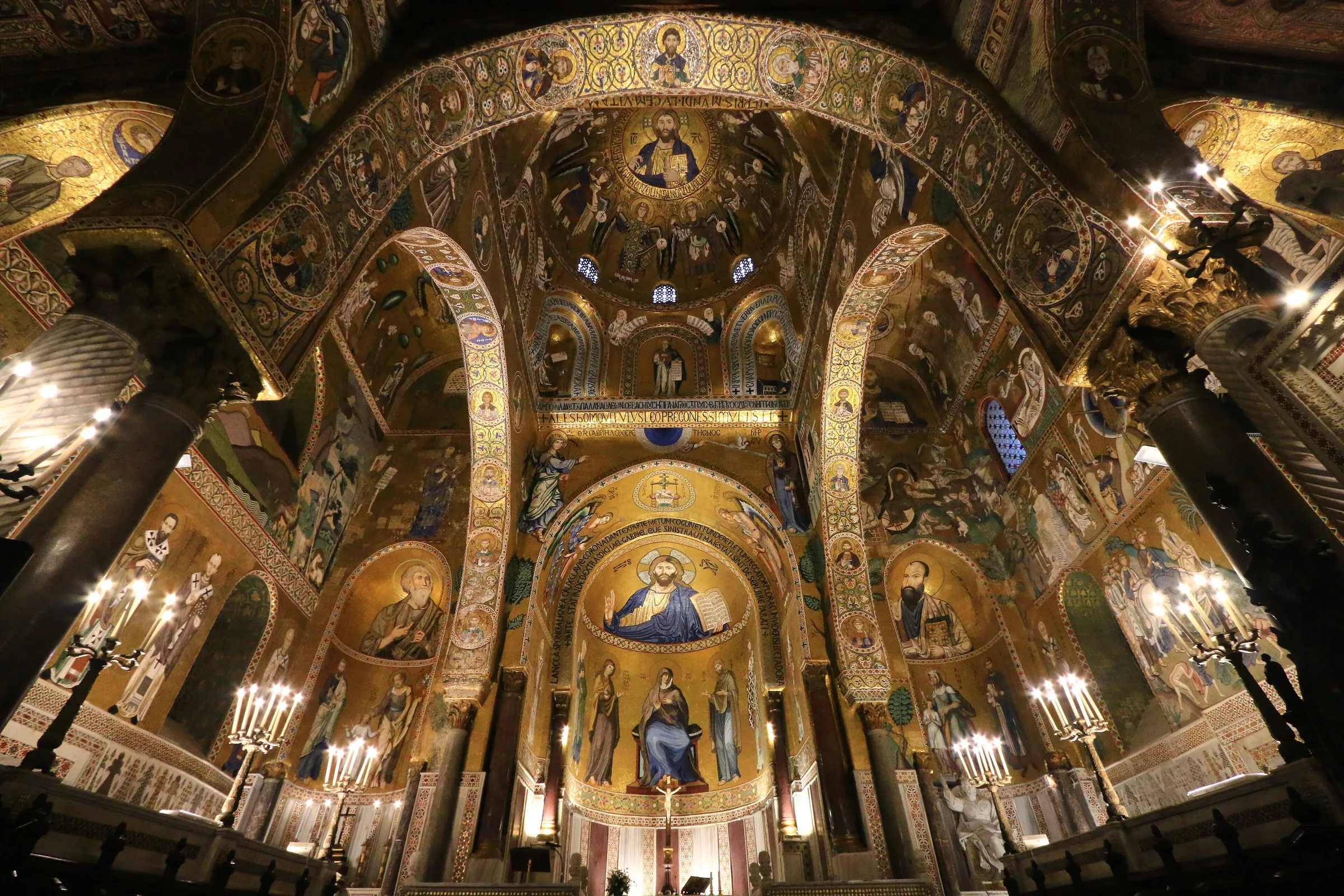
Step inside and the first sensation is light. The upper walls, arches and vaults are sheathed in mosaic set against a ground of gold, made from tiny glass tesserae backed with gold leaf and tilted so that they catch and scatter the light of candles and windows. The effect the Byzantine designers intended was not decoration but transformation: the visitor should feel lifted out of the ordinary world into a golden heaven.

The program is anchored by two great images of Christ. In the dome above the sanctuary reigns the Christ Pantocrator — Christ "Ruler of All" — his right hand raised in blessing, a book in his left, his gaze fixed and eternal, encircled by archangels and angels. A second Pantocrator fills the semi-dome of the central apse, presiding over the altar below, so that the worshipper meets the same commanding figure twice as the eye travels through the sacred east end.

Around these central images unfolds a full celestial hierarchy. Ranks of angels and archangels attend the dome. Prophets and evangelists occupy the transitions between curved and flat surfaces, their names inscribed, many in Greek, marking the Byzantine hand at work. Standing saints — bishops, warriors, holy monks and deacons — line the walls in solemn frontal poses, gold haloes merging into the gold field behind them.

The craftsmanship rewards close attention. Faces are modelled in graduated tones of glass, drapery falls in confident linear folds, and the slight irregularity of the hand-set tesserae gives the surfaces a living shimmer that no flat painting could match. This is Byzantine mosaic at its height, produced far from Constantinople yet fully within its tradition, and it turns the whole upper chapel into a single continuous vision of the divine order.

解讀牆上的聖經循環故事

Below and around the great figures of Christ, saints and angels, the mosaics tell stories. The Cappella Palatina's walls carry extended narrative cycles drawn from scripture, arranged so that a visitor moving through the chapel effectively reads the sacred history of the world laid out in gold.

The nave presents scenes from the Old Testament, beginning with Creation and the early chapters of Genesis. The account moves through the making of the world, the forming and fall of humankind, Noah and the Flood, and the stories of the patriarchs, each episode compressed into a legible tableau with figures, landscape and inscribed labels. The cumulative sweep gives the nave the character of an illustrated book, its pages turned by walking.

In the eastern parts of the chapel, closer to the altar, the emphasis shifts to the New Testament and the life of Christ — the great feasts and miracles that Byzantine churches traditionally set near the sanctuary. Elsewhere the cycles honour the apostles Peter and Paul, whose missionary journeys and acts are recounted in their own sequences, reflecting the chapel's ties to both the Eastern Church and Latin Rome.

What makes these cycles so satisfying is their clarity. The designers understood that a viewer at floor level needed to grasp each scene quickly, so gestures are broad, compositions uncrowded, and the gold ground isolates every figure. Colour is used sparingly and to purpose — a deep blue robe, a flash of vermilion — against the dominant gold. Read patiently, the walls reveal a carefully ordered theology: Creation and Fall in the body of the chapel, redemption gathered toward the altar, and the mission of the Church carried outward through its saints. Bring time, and let the eye follow the narrative rather than merely admiring the glitter.

彩繪蜂巢天花板:頭頂上的伊斯蘭世界

Then you look up, and the chapel changes character entirely. Over the nave hangs a wooden ceiling of muqarnas — the honeycomb, or stalactite, vaulting that is one of the signature forms of Islamic architecture. Built from carved and fitted timber rather than stone, it descends in tier upon tier of small niches, pendants and star-shaped recesses, a geometric cascade that seems to hang above the Christian chapel like a canopy from another world.

This ceiling is the work of Fatimid-trained craftsmen, and it brings the artistic vocabulary of the wider Islamic Mediterranean into the heart of a Norman royal foundation. Its surfaces are not left plain but richly painted. Among the intricate geometric and vegetal ornament runs a program of courtly imagery: figures at leisure and in celebration, drinkers and musicians, dancers, hunters, animals and birds, arranged within the small facets of the honeycomb. This is the secular, pleasure-loving iconography of a princely court, the same visual culture found across the medieval Islamic world.

The result is one of the most remarkable juxtapositions in all of medieval art. A Christian chapel, roofed in Byzantine gold along its walls, is crowned overhead by an Islamic ceiling painted with worldly delights — and the two do not fight. Roger's designers set them in dialogue, sacred order rising up the walls and courtly splendour arching over the nave, both serving the same royal patron.

Because the painted scenes are small and high, they reward patience and, ideally, a slow scan across the ceiling's length. Much of the finest early painting of the Islamic Mediterranean survives poorly elsewhere; here it endures, sheltered inside a functioning chapel. Standing beneath the muqarnas, you are looking at a rare and precious survival — Fatimid courtly art preserved by a Christian king.

科斯馬蒂地板、講道壇與復活節燭台

The Cappella Palatina's splendour does not stop at the level of the mosaics. Look down, and the floor is a masterpiece in its own right: Cosmatesque work, the inlaid marble technique in which small pieces of coloured stone — porphyry, serpentine, precious marbles, some salvaged from far older Roman monuments — are cut and set into swirling geometric patterns of circles, bands and interlace. The lower walls carry the same treatment, panelled in polished marble and inlay, so that the whole lower zone of the chapel glows with a quieter, mineral richness beneath the golden fire above.

This banded, patterned marble was a Roman and Italian tradition, and its presence completes the chapel's cultural equation: Latin stonework below, Byzantine mosaic on the walls, Islamic woodwork overhead. The eye is carried from earth to heaven through three distinct artistic languages.

Two furnishings deserve particular attention. Rising beside the sanctuary is the marble ambo, or pulpit, from which the scriptures were proclaimed — an elevated platform on slender columns, decorated with the same inlaid marble and mosaic ornament that unifies the chapel. Beside it stands the great Paschal candlestick, a tall carved marble column that held the Easter candle. Its shaft is worked in dense relief with intertwined figures, foliage, animals and biblical motifs climbing toward the flame, a virtuoso piece of Romanesque carving that repays circling slowly.

Together the floor, ambo and candlestick show that the chapel was conceived as a total work of art, in which no surface and no object was left ordinary. Even the fittings needed for the liturgy — the place of preaching, the light of Easter — were made into sculpture. To appreciate the Cappella Palatina fully is to give the marble as much attention as the gold.

三種文化,一座傑作:UNESCO列名緣由

The deepest reason the Cappella Palatina moves people is not any single element but the fusion of all of them. Nowhere else are Byzantine, Islamic and Latin artistic traditions brought together so completely, so early, and so harmoniously within one small space. The chapel is the physical proof of a brief, extraordinary moment when Norman Sicily governed a genuinely plural society and chose to express that plurality in stone, glass and gilded wood.

Each tradition keeps its own voice. The mosaics are unmistakably Byzantine, down to their Greek inscriptions and the fixed gaze of the Pantocrator. The muqarnas ceiling is unmistakably Islamic, in both its form and its courtly painted imagery. The plan and the Cosmatesque marble are Latin and Italian. Yet a single royal will bound them into one coherent room, and the seams, far from being flaws, are the whole point. The chapel does not blend the three cultures into mush; it holds them together in dialogue, each enriching the others.

This is why, in 2015, the Cappella Palatina was inscribed on the UNESCO World Heritage List as part of "Arab-Norman Palermo and the Cathedral Churches of Cefalù and Monreale." The listing recognises a whole cluster of monuments in and around Palermo that embody this same synthesis, and the Palatine Chapel is its jewel — the most concentrated, best-preserved expression of the Arab-Norman-Byzantine culture that flourished on the island in the twelfth century.

To visit is to witness a road not taken by much of medieval Europe: a court that treated the artistic achievements of three faiths as treasures to be gathered rather than rivals to be shunned. That openness, made permanent in gold and painted timber, is what gives the Cappella Palatina its lasting power — and what makes standing inside it feel less like sightseeing than like time travel.

造訪時如何好好欣賞馬賽克鑲嵌畫

The Cappella Palatina rewards preparation, because its glory is in the detail and the light. Aim to arrive with time in hand and, if you can, when the chapel is calmer — earlier in the day tends to be quieter, and the low, raking light can make the gold tesserae shimmer especially vividly. Give yourself long enough to look up at the muqarnas, down at the Cosmatesque floor, and slowly along the biblical cycles, rather than sweeping through in a few minutes.

A short official audioguide is available for a small extra fee and helps you locate the two Christ Pantocrator images, follow the Genesis narrative along the nave, and pick out the courtly figures painted in the ceiling. Even without it, a simple plan of attack helps: read the walls east to west as a story, then step back and take in the whole golden envelope as one composition.

We are a concierge service that arranges and secures your entry in advance for your chosen date, so you can concentrate on the art rather than the logistics. Entry is valid on the date you select rather than a fixed clock time, which gives you welcome flexibility around a morning of sightseeing in the Norman palace quarter. If you hold a reduced, senior or youth rate, carry the valid ID or proof that qualifies you, as it must be shown at entry.

A few timing notes shape the day. The chapel closes to visitors on Sunday and religious-holiday mornings, roughly 09:45 to 11:15, for Mass, and those days have shorter hours overall. The adjoining Royal Apartments, with their secular hunting mosaics, are open only Friday to Monday, so plan a Friday-to-Monday visit if you want to see those rooms as well. Either way, the mosaics of the chapel itself are the reason to come.

常見問題

帕拉提納禮拜堂(Cappella Palatina)是由誰建造的?又是何時興建?

這座禮拜堂由西西里第一位諾曼國王羅傑二世(King Roger II)下令興建。工程始於1132年,位於巴勒摩的諾曼宮(Palazzo dei Normanni)內,禮拜堂於1140年祝聖啟用。其金色馬賽克鑲嵌畫於1140年代及之後數十年間陸續完成,使這座禮拜堂成為羅傑的皇家聖堂,也是他統治權力的宣示。

穆卡納斯(muqarnas)天花板是用什麼材料製成?它為何如此特別?

穆卡納斯是一種蜂巢狀或鐘乳石狀的天花板,由受法蒂瑪王朝訓練的工匠以雕刻並彩繪的木料打造而成。它懸掛於中殿上方,層層疊疊的小壁龕中繪有宮廷生活場景——樂師、獵人、動物與閒適的人物。這類罕見的伊斯蘭藝術珍品保存於基督教禮拜堂內,使其成為這座建築最偉大的寶藏之一。

禮拜堂內有哪兩幅基督聖像?

帕拉提納禮拜堂內藏有兩幅拜占庭風格的「萬王之王」基督普世君王(Christ Pantocrator)馬賽克鑲嵌畫。一幅位於聖所上方的穹頂,四周環繞天使;另一幅則高踞於主祭壇上方的中央半圓後殿。當您向東望去,兩次遇見這尊威嚴莊嚴的形象,正是這座禮拜堂設計的核心巧思。

帕拉提納禮拜堂為何名列聯合國教科文組織世界遺產?

2015年,它被列入「阿拉伯–諾曼時期的巴勒摩,以及切法盧與蒙雷阿萊主教座堂」(Arab-Norman Palermo and the Cathedral Churches of Cefalù and Monreale)世界遺產項目。這項登錄肯定了諾曼統治下拜占庭、伊斯蘭與拉丁文化的交融。這座禮拜堂正是其中最精緻且保存最完好的典範,在同一空間內結合了金色馬賽克、伊斯蘭穆卡納斯天花板與科斯馬蒂(Cosmatesque)大理石工藝。

禮拜堂在白天是否會暫停對遊客開放?

會的。週日與宗教節日期間,禮拜堂會因舉行彌撒而暫停對遊客開放,大約從上午09:45至11:15,且這些日子的整體開放時間較短,最後入場時間也較早。若想在最寧靜的氛圍中欣賞馬賽克鑲嵌畫,平日較早抵達往往是收穫最豐的參觀時機。