免排隊入場 阿拉伯-諾曼帕勒摩:圍繞禮拜堂的行程規劃
如何以帕拉提納禮拜堂為核心,規劃一至兩天的帕勒摩行程,沿途飽覽聯合國教科文組織路線上的金色馬賽克、紅色圓頂與大教堂。
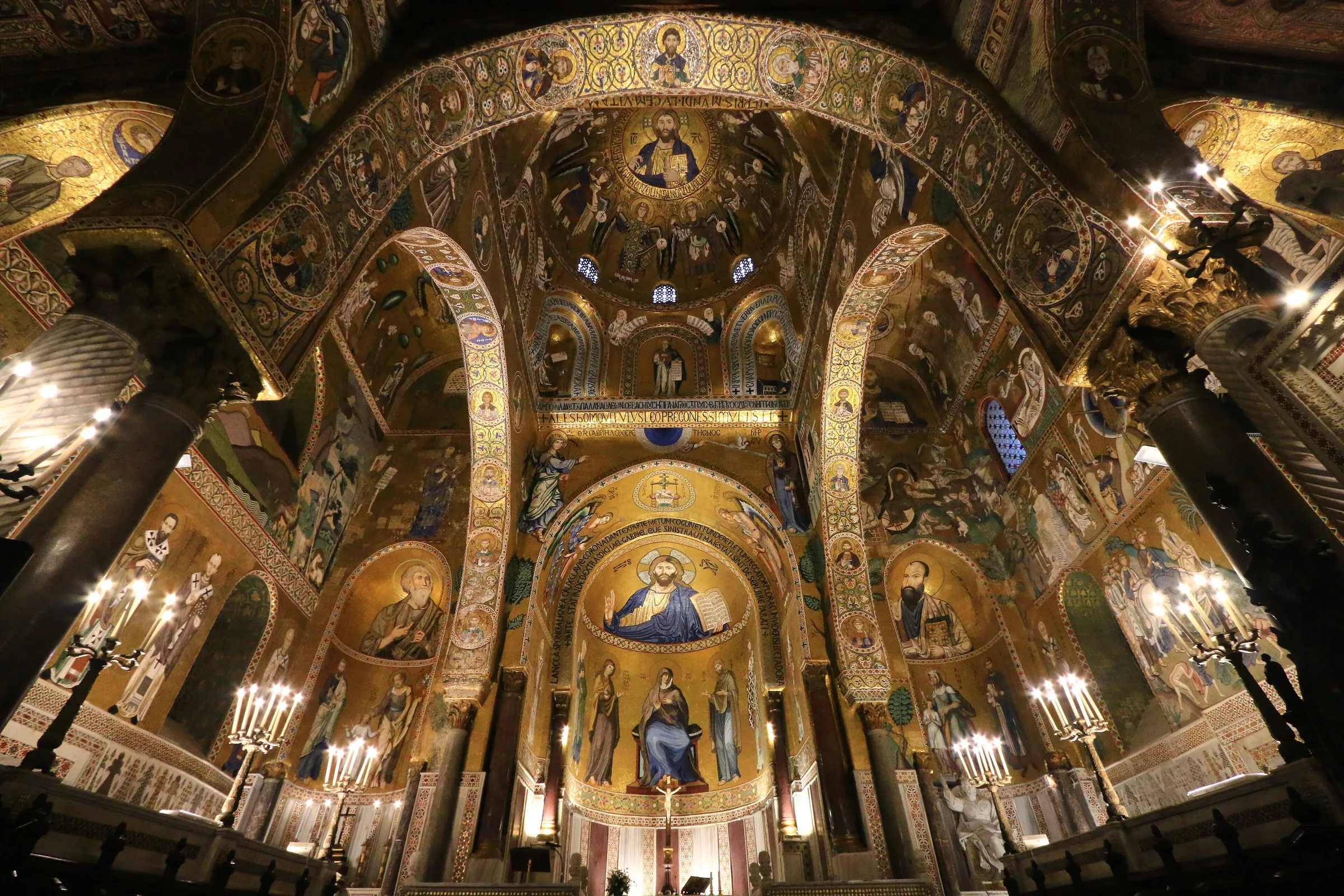
帕拉提納禮拜堂是西西里島偉大文化路線中的璀璨明珠。以下說明如何將它與帕勒摩其他阿拉伯-諾曼景點串聯,打造一趟節奏流暢的單一行程。
2015年聯合國教科文組織路線及其涵蓋範圍
In 2015 UNESCO added a cluster of Palermo monuments to the World Heritage List under a single title: "Arab-Norman Palermo and the Cathedral Churches of Cefalu and Monreale." It is not one building but a network of nine, spread across the city and two nearby towns, all dating from the twelfth-century Norman kingdom of Sicily. What ties them together is a shared visual language: Byzantine mosaic technique, Islamic craft and ornament, and Western Romanesque architecture fused into something that existed nowhere else. The Cappella Palatina, the royal chapel on the piano nobile of the Palazzo dei Normanni, is the supreme statement of that synthesis and the natural anchor for any itinerary. Commissioned by King Roger II, begun in 1132 and consecrated in 1140, it brings together golden wall-and-vault mosaics, a Fatimid-style painted wooden muqarnas ceiling, Cosmatesque inlaid marble and a Latin basilica plan under one roof. The other inscribed sites extend the same story outward. Within Palermo they include the palace itself, Palermo Cathedral, the churches of San Giovanni degli Eremiti, San Cataldo, Santa Maria dell'Ammiraglio (the Martorana), the small Church of San Giovanni dei Lebbrosi, and the pleasure palace known as the Zisa, along with the arched Ammiraglio bridge. Beyond the city sit the two great cathedral churches that complete the title: Monreale, above the Conca d'Oro, and Cefalu, on the coast to the east. Understanding the route this way helps you plan. You do not need to see all nine to grasp the theme, but a good Palermo visit treats the chapel as the centre and radiates out to two or three of the others, choosing by proximity and by how much mosaic you want to absorb in a day. The sections below group the sights by how easily they pair with a chapel visit, so you can assemble a route that matches your pace rather than chasing a checklist.
就在隔壁:聖喬瓦尼德利埃雷米蒂與皇宮園區
The easiest additions to a chapel visit are the ones you can reach on foot in minutes, and the closest of all is San Giovanni degli Eremiti. Its cluster of bulbous red domes, rising just downhill from the Palazzo dei Normanni, is one of the most photographed silhouettes in Palermo and a shorthand for the city's Arab-Norman character. The domes are unmistakably Islamic in form, set over a spare Norman church, and the quiet cloister and garden beside it make a calm counterpoint to the density of the chapel's mosaics. Because it is so near the palace, it slots naturally into the same half-day without any transport at all. Before you leave the palace itself, give time to what your chapel ticket may include beyond the chapel. The combined admission covers the Palatine Chapel together with the Royal Apartments, the Royal Gardens, the permanent exhibition and the archaeological area. The Royal Apartments, or Sale Reali, are the highlight of that wider visit: they hold the Sala di Ruggero, Roger's Hall, decorated with secular mosaics of hunting scenes, peacocks and leopards that show the same workshops turning their skill to worldly subjects rather than sacred ones. There is an important catch to plan around. The Royal Apartments open only Friday to Monday; on Tuesday, Wednesday and Thursday they are closed, and the ticket price is the same whether or not they are accessible. If seeing the Sala di Ruggero matters to you, weight your visit toward a Friday-to-Monday window. The Palazzo dei Normanni is itself the oldest royal residence in Europe and still serves as the seat of the Sicilian Regional Assembly, so parts of the complex are working government space rather than museum. Combining the chapel, the apartments, the gardens and San Giovanni degli Eremiti gives you a compact, entirely walkable morning built around a single ticketed entry.
步行下坡片刻:帕勒摩大教堂與舊城核心
From the palace, the obvious next move is downhill toward the heart of the old city. Palermo Cathedral stands roughly a fifteen-to-twenty-minute walk away along Corso Vittorio Emanuele, the straight ceremonial spine that runs past the Porta Nuova gate beside the palace. The cathedral is part of the same UNESCO inscription and rewards the short stroll: its long exterior is a layered record of the city's rulers, mixing Norman fabric with later Gothic, Catalan and Baroque additions and a dome added centuries after its founding. Look for the reused column near the southern porch carved with a Qur'anic inscription, a literal fragment of Islamic Palermo built into a Christian cathedral, and a neat illustration of why this route exists. Inside, the atmosphere is very different from the chapel: cooler, plainer, monumental rather than jewel-like, with the royal and imperial tombs of Sicily's medieval rulers gathered in porphyry. Continuing down the same street brings you to the Quattro Canti, the octagonal Baroque crossroads where Palermo's four historic quarters meet, and a few steps beyond it Piazza Pretoria with its crowded fountain. This is also the doorway to the Martorana and San Cataldo on nearby Piazza Bellini, two more inscribed churches; the Martorana keeps some of the oldest Byzantine mosaics in Sicily, and San Cataldo wears the same red domes as San Giovanni degli Eremiti. Threading these together makes the cathedral leg feel less like a single stop and more like a slow descent through the medieval city, monument by monument, all within a compact walking radius. Because the corso links the palace to the cathedral so directly, this pairing is the backbone of most one-day plans. Do it in whichever direction suits your timings: chapel first thing, then downhill to the cathedral and the Quattro Canti for lunch, or the reverse if you want to reach the palace for a quieter late-morning slot. Either way the walking is easy and almost entirely along one memorable street.
值得專程前往:蒙雷阿萊與切法盧
The two sights that give the UNESCO title its full name sit outside Palermo, and both are worth the journey for anyone who falls for the chapel's mosaics. Monreale Cathedral is the closer of the two, perched on the slope above the city about twenty minutes out, reachable by local bus or taxi. If the Cappella Palatina is the perfect miniature of Arab-Norman mosaic art, Monreale is the same vision at overwhelming scale: acres of gold-ground mosaic sheathe the nave and apse, culminating in a colossal Christ Pantocrator whose outstretched hands span the width of the sanctuary. The narrative cycles run through the whole biblical story in luminous panels, and the adjoining cloister, ringed by hundreds of paired columns with individually carved capitals, is a masterpiece in its own right. Many visitors find Monreale the emotional peak of the whole route, and it pairs best as a dedicated half-day rather than a rushed add-on. Cefalu lies further off, about an hour east along the Tyrrhenian coast and easily reached by train, which makes it a natural full-day excursion rather than a same-day pairing with the chapel. Its cathedral rises against a dramatic rock headland above a compact medieval town and a swimmable beach, and its apse holds another towering Pantocrator mosaic, widely considered among the finest and most serene of the Norman commissions. Seeing the three great Pantocrators in turn, the chapel's, Monreale's and Cefalu's, is one of the most rewarding threads you can follow through Sicily, each version subtly different in mood. If your time is tight, prioritise Monreale, which delivers the grandest mosaics for the least travel. If you have a spare day and want to combine art with a seaside town, add Cefalu at the start or end of your stay. Trying to do the chapel, Monreale and Cefalu all in one day is possible but punishing; the two-day plan below spreads them out so each gets the attention it deserves.
超越馬賽克:齊薩宮、馬西莫劇院與市集
Palermo is more than its Norman churches, and a good itinerary leaves room for the layers that came before and after. The Zisa, another site on the UNESCO list, is a twelfth-century summer palace built for the Norman kings in a frankly Islamic idiom, with a cool central hall, a fountain channel and muqarnas vaulting designed to move air and water through the heat. It stands a little west of the centre and makes a rewarding short detour for anyone who wants to see the same Arab-Norman craft applied to secular pleasure rather than worship. For a complete change of register, Teatro Massimo, the vast neoclassical opera house near the top of Via Maqueda, is one of the largest theatres in Europe and offers guided visits of its auditorium and grand staircases; even from the outside its steps are a fine place to pause. The city's real pulse, though, is in its street markets. Ballaro, the oldest and most atmospheric, spreads through the Albergheria quarter just below the palace, so it slots easily into a chapel day: stalls of fish, citrus, olives and grilled street food under a canopy of awnings, loud and unpolished and thoroughly Sicilian. It is one of the best places in the city to eat cheaply and well between monuments. On the sombre side, the Capuchin Catacombs on the western edge of the centre hold thousands of preserved and dressed bodies in long corridors, a genuinely unusual and unsettling sight that fascinates some visitors and is best skipped by others; decide honestly whether it suits your group before adding it. Woven together, these stops turn a monument tour into a portrait of the living city, and they give useful ballast to an itinerary that could otherwise become an unbroken run of golden interiors. Choose one or two according to taste rather than trying to fit them all; the point is contrast, not completeness.
以禮拜堂為核心的一日行程
If you have a single day in Palermo, build it around a morning at the Cappella Palatina, when the light in the chapel is at its best and the crowds are thinnest. Entry is tied to your chosen date rather than a fixed clock time, so aim to arrive not long after opening, around the start of the day, and give the mosaics unhurried time before moving on. Two planning points shape the morning. First, if you are visiting between Friday and Monday, you can continue straight from the chapel into the Royal Apartments and the Sala di Ruggero on the same ticket; from Tuesday to Thursday those rooms are closed, so build your day around the chapel, gardens and exhibition instead. Second, if your only free day is a Sunday or a religious holiday, note that the chapel closes to visitors for Mass in the late morning and keeps shorter hours, with last admission around midday rather than late afternoon; on a Sunday you should arrive early and not linger over breakfast. After the palace, walk down to San Giovanni degli Eremiti and its red domes just below, then continue along Corso Vittorio Emanuele to Palermo Cathedral, roughly fifteen to twenty minutes on foot past the Porta Nuova. Break for lunch at Ballaro market or around the Quattro Canti, then spend the afternoon on the churches of Piazza Bellini, the Martorana and San Cataldo, before finishing at Teatro Massimo as the day cools. This route keeps almost all the walking within the old core and needs no transport, which is what makes it comfortable in a day. Carry ID if you are travelling on a reduced, youth or senior ticket, since proof of age or status is checked at entry. If you would rather trade one city stop for grandeur, drop the afternoon churches and take the short trip up to Monreale instead, returning to the centre for the evening.
兩日行程規劃與融合之美為何重要
Two days let the route breathe. Spend the first day in the historic centre exactly as above: the Cappella Palatina and the palace in the morning, San Giovanni degli Eremiti next door, then the walk down to Palermo Cathedral, the Quattro Canti, the Piazza Bellini churches and Ballaro market, with Teatro Massimo or the Zisa to fill any gaps. This day is deliberately walkable, so you finish it with a feel for how the medieval city fits together. Give the second day to the sights that need travel. Go up to Monreale in the morning, when its vast golden nave is quietest, and spend real time in both the cathedral and the cloister rather than rushing back. Depending on your energy and transport, either return to Palermo for the Capuchin Catacombs and a slower afternoon, or, if you have booked ahead and want the coast, take the train east to Cefalu for its Pantocrator, its old town and its beach, treating that as a full-day outing in its own right. Seeing the chapel's mosaics first gives you the vocabulary to read Monreale and Cefalu properly; by the third Pantocrator you notice how each workshop varied the same commission. What makes this itinerary special is the fusion it traces. For a few generations, Norman kings ruled a Sicily where Greek, Latin and Arabic were all spoken, and they hired Byzantine mosaicists, Islamic craftsmen and Western masons to work side by side. The result, distilled in the Cappella Palatina's golden walls, muqarnas ceiling and inlaid marble, is a rare moment when three great Mediterranean traditions produced a single coherent style rather than competing. Following the route from the chapel outward to the cathedrals is really following that idea across a landscape, which is why the chapel makes such a satisfying centre: everything else in Arab-Norman Palermo becomes an echo or an amplification of what you saw there first.
常見問題
2015年聯合國教科文組織阿拉伯-諾曼帕勒摩登錄涵蓋哪些內容?
涵蓋十二世紀的七座古蹟,融合拜占庭、伊斯蘭與諾曼風格:諾曼宮(Palazzo dei Normanni)及其帕拉提納禮拜堂(Cappella Palatina)、巴勒摩主教座堂(Palermo Cathedral)、聖喬瓦尼德利埃雷米蒂教堂(San Giovanni degli Eremiti)、聖卡塔爾多教堂(San Cataldo)、馬爾托拉納教堂(Martorana)、聖喬瓦尼德伊萊布羅西教堂(San Giovanni dei Lebbrosi)、齊薩宮(Zisa)與阿米拉格里奧橋(Ammiraglio bridge),另有蒙雷阿萊主教座堂(Monreale)與切法盧主教座堂(Cefalu)。
我可以在同一天參觀帕拉提納禮拜堂和蒙雷阿萊嗎?
可以,但會是滿滿一整天的行程。上午參觀禮拜堂與諾曼宮,接著前往蒙雷阿萊,車程約二十分鐘,安排下午時段。若同一天還想加入海邊的切法盧,會過於倉促,建議另排一天單獨前往。
哪些阿拉伯-諾曼景點離帕拉提納禮拜堂最近?
聖喬瓦尼德利埃雷米蒂教堂擁有紅色圓頂,就位於諾曼宮下方不遠處,步行幾分鐘即可抵達。沿著維托里奧·埃馬努埃萊大道(Corso Vittorio Emanuele)步行約十五至二十分鐘可到巴勒摩主教座堂,巴勒摩的巴拉羅市場(Ballaro)就在宮殿下方,因此安排緊湊的一日行程完全不需要交通工具。
從巴勒摩出發,蒙雷阿萊和切法盧哪個更值得一遊?
蒙雷阿萊距離較近,車程約二十分鐘,擁有規模最大的金色馬賽克,若時間有限應優先造訪。切法盧則在東方約一小時火車車程,除了潘托克拉托(Pantocrator)馬賽克,還有中世紀小鎮與海灘,適合安排一整天的行程,而非匆匆搭配的半日遊。
參觀禮拜堂需要配合開放日規劃行程嗎?
是的。門票僅限所選日期當日有效。皇家寓所(Royal Apartments)僅於週五至週一開放,建議安排此時段造訪,才能看到魯傑羅廳(Sala di Ruggero)。週日與宗教節日時,禮拜堂會於上午稍晚關閉以舉行彌撒,開放時間較短,建議提早抵達。